
Choose a 50-Meter Bubble Wrap Roll That Fits Your Parcel Volume
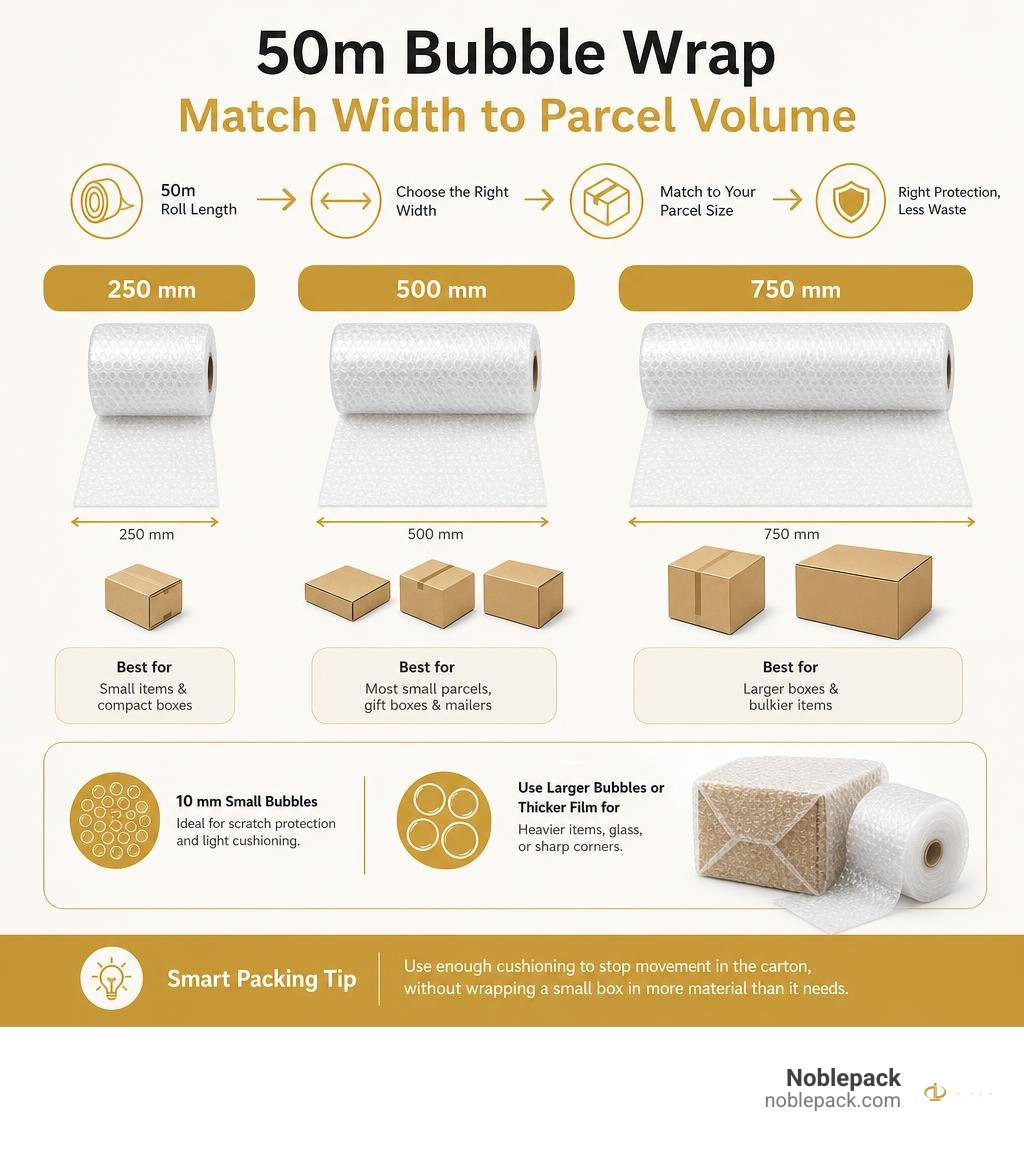
A 50-meter bubble wrap roll is a practical choice when you pack a steady number of small parcels but do not want a bulky 100-meter roll taking over your workspace. Start by matching the roll width to your boxes: a 500 mm wide roll provides 25 m2 of coverage over 50 meters and suits many jewelry mailers, gift boxes, and small shipping cartons.
For premium small-box packing, choose 10 mm small bubbles for scratch protection and light cushioning. Use thicker film, larger bubbles, or extra layers when a box contains glass displays, heavier accessories, or items with sharp corners. A 50 m roll also helps control stock costs: it is easier to store, handle, and replace before aged packaging takes up space.
The goal is simple: use enough cushioning to stop movement in the carton, without wrapping a small branded box in more material than it needs.
I am Dannah Davies, and this guide will help you match bubble wrap supply to your box sizes, packing volume, and protection needs.
Key Specifications: Bubble Dimensions, Thickness, and Formats
Selecting protective packaging requires understanding the technical attributes that determine shock absorption, film resilience, and operational efficiency. Protective air film is manufactured primarily from low-density polyethylene (LDPE). Its performance depends on bubble diameter, material density, ply structure, and specialized manufacturing treatments.
Bubble Diameter and Height
Air pockets are formed in standardized profiles engineered for specific cushioning functions:
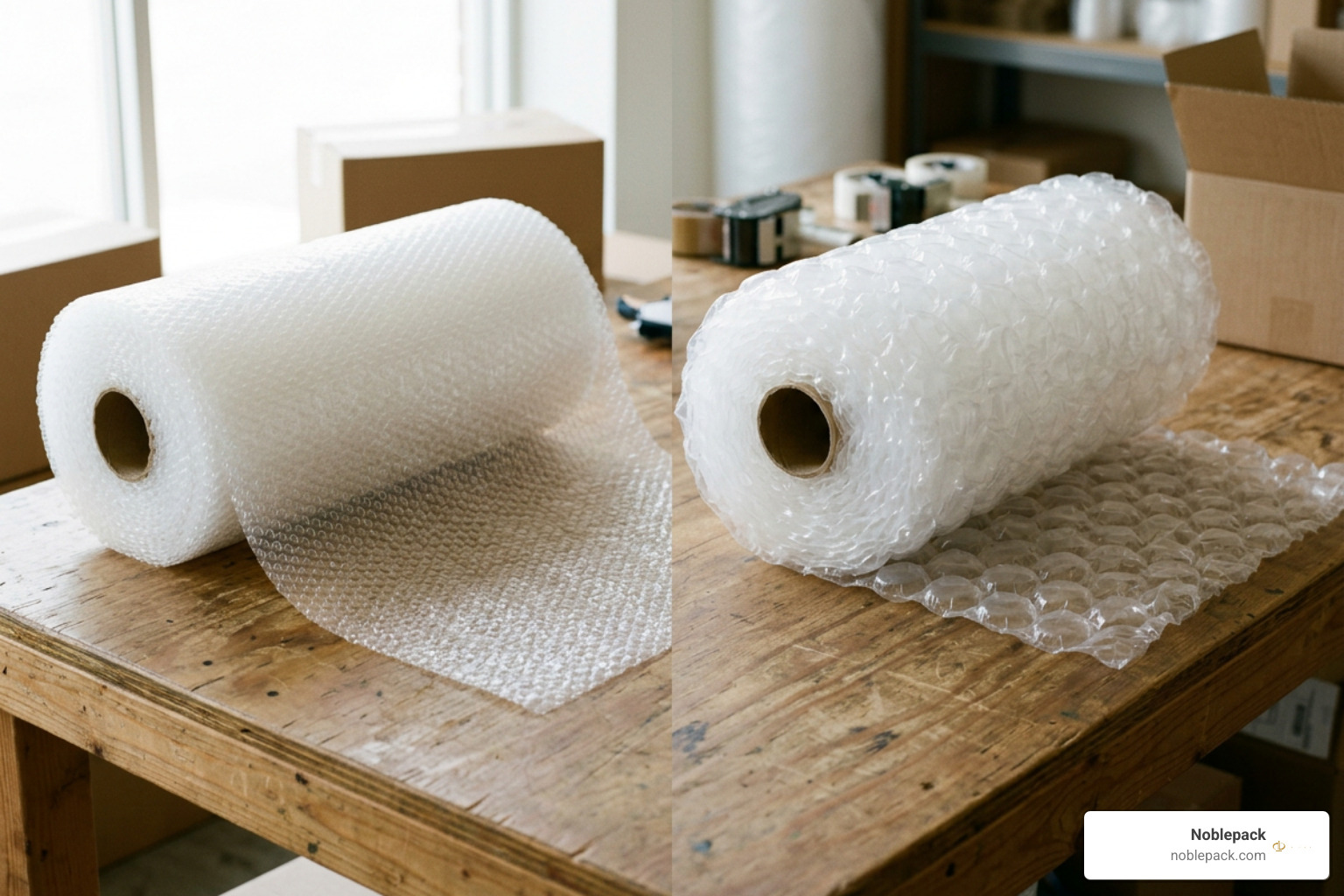
- Small Bubbles (6 mm to 10 mm diameter, ~4–5 mm height): The standard P10 profile (10 mm diameter) offers contouring flexibility. It acts as an intimate barrier against friction, fine abrasions, and minor transit vibrations.
- Large Bubbles (20 mm to 30 mm diameter, ~10 mm height): Designed for heavy-duty shock absorption, large air cells provide significant deflection under load. They absorb severe impacts and fill empty void spaces inside shipping cartons to prevent internal movement.
Film Thickness: Micron Ratings vs. GSM
Durability is defined using two primary metrics:
- Microns ($\mu\text{m}$ / my): Indicates linear film thickness. Lightweight applications rely on 45 to 60 my films. Medium-duty shipping standards generally operate around 50 my to 75 my. Heavy-duty transit, export cargo, and puncture-prone items utilize 80 my to 150 my films.
- GSM (Grams per Square Meter): Measures areal plastic density. Standard protective packaging typically ranges from 30 GSM (economical, light duty) and 50 GSM (balanced transit duty) up to 70–300 GSM for industrial-grade resistance.
Ply Construction: 2-Ply vs. 3-Ply LDPE
The structural rigidity of bubble film is dictated by its layer count:
- 2-Ply LDPE: Manufactured by laminating one flat base sheet to a thermoformed bubble sheet. This structure is flexible, cost-effective, and conforms tightly around intricate geometries.
- 3-Ply LDPE: Features air bubbles sandwiched between two flat outer sheets. This encloses the air pockets completely, delivering a smooth exterior on both sides. It increases structural stiffness, burst resistance, and compressive strength without adding disproportionate bulk.
Dispensing Formats: Perforated vs. Continuous
To optimize packing line ergonomics, continuous rolls are often modified during conversion:
- Perforated Rolls: Manufactured with micro-perforations at standardized intervals (such as 300 mm or 500 mm). This enables clean, tool-free sheet separation, standardizing material consumption and improving packaging speed.
- Continuous Rolls: Provide complete flexibility to cut custom sheet lengths for variable order sizes, avoiding excess material scrap.
Small vs Large Bubbles for Fragile Item Protection
Selecting between small and large bubble geometries depends on product weight, exterior finish fragility, and shipping container clearance.

Small bubbles excel at surface interleaving and scratch prevention. When packing polished items, lacquered presentation boxes, or fine jewelry collections, small 10 mm bubbles contour snugly around edges. They prevent abrasion caused by transit vibration while keeping overall package dimensions compact.
Large bubbles (20 mm to 30 mm) are engineered for heavy freight, structural cushioning, and void fill. When a carton contains empty space, a single layer of large bubble wrap fills gaps quickly, locking products firmly in the center of the carton to prevent movement during transit.
| Specification Feature | Small Bubble Profile (e.g., 10 mm P10) | Large Bubble Profile (e.g., 20–30 mm) |
|---|---|---|
| Bubble Diameter | 6 mm – 10 mm | 20 mm – 30 mm |
| Bubble Height | 4 mm – 5 mm | Up to 10 mm |
| Primary Function | Surface protection, anti-scratch, contour wrapping | Shock absorption, impact deceleration, void fill |
| Best Product Fit | Jewelry boxes, cosmetics, fine ceramics, glassware | Heavy decor, bulk freight, framed displays, large electronics |
| Flexibility / Drape | High conformability around tight edges | Moderate conformability; bulkier profile |
| Space Efficiency | Minimal addition to dimensional shipping weight | Higher volume displacement within outer cartons |
Specialized Formats: Tubing, Antistatic, and Barrier Films
Beyond standard flat sheeting, specialized formats resolve specific packaging challenges:
- Bubble Wrap Tubing: Available in continuous roll formats (such as 500 mm widths across 50-meter lengths), tubing allows packers to insert long, irregular, or cylindrical products directly into a protective sleeve. Cutting the exact length needed and sealing the ends eliminates manual folding, seam-taping, and excess material scrap.
- Antistatic ESD Films: Colored pink for clear warehouse identification, antistatic bubble wrap incorporates topical or intrinsic dissipative agents. These dissipate static surface charges, preventing electrostatic discharge (ESD) from damaging sensitive electronic assemblies, smart accessories, or metallic components.
- Barrier and Laminated Films: Multi-layer formulations incorporate nylon or PET/ALU barrier layers. These barrier films prevent gradual air diffusion through the plastic membrane, maintaining air retention over multi-month transit and storage periods. Laminated PET/ALU variations also provide thermal reflection for temperature-sensitive shipments.
- Recycled-Content Formulations: High-performance protective films frequently integrate 30% to 75% post-industrial or post-consumer recycled LDPE. These configurations match virgin plastic puncture resistance while supporting closed-loop sustainability objectives.
Why Choose Bubble Wrap 50 Meter Rolls for Your Packaging Operations
Operational packaging efficiency relies on balancing material access with workstation organization. A compact 50-meter roll offers distinct advantages for retail operations, boutique fulfillment stations, and medium-volume shipping benches.

- Ergonomic Handling and Workstation Footprint: A 100-meter or 200-meter roll of large bubble wrap can exceed 80 cm in overall diameter, crowding packing tables. A 50-meter roll occupies half the physical volume, mounting easily on overhead packaging benches or under-table dispensers without obstructing movement.
- Inventory Turnover and Cleanliness: Packaging materials stored in active warehouse environments attract dust and particulate matter over time. Using 50-meter rolls maintains rapid inventory turnover, ensuring wrap applied to premium customer orders remains clean and free of airborne debris.
- Freight and Distribution Agility: Smaller 50-meter rolls fit standard courier transport limits more easily than bulk master bundles, lowering incoming freight costs for small-footprint urban fulfillment hubs.
Estimating Parcel Output from a Bubble Wrap 50 Meter Roll
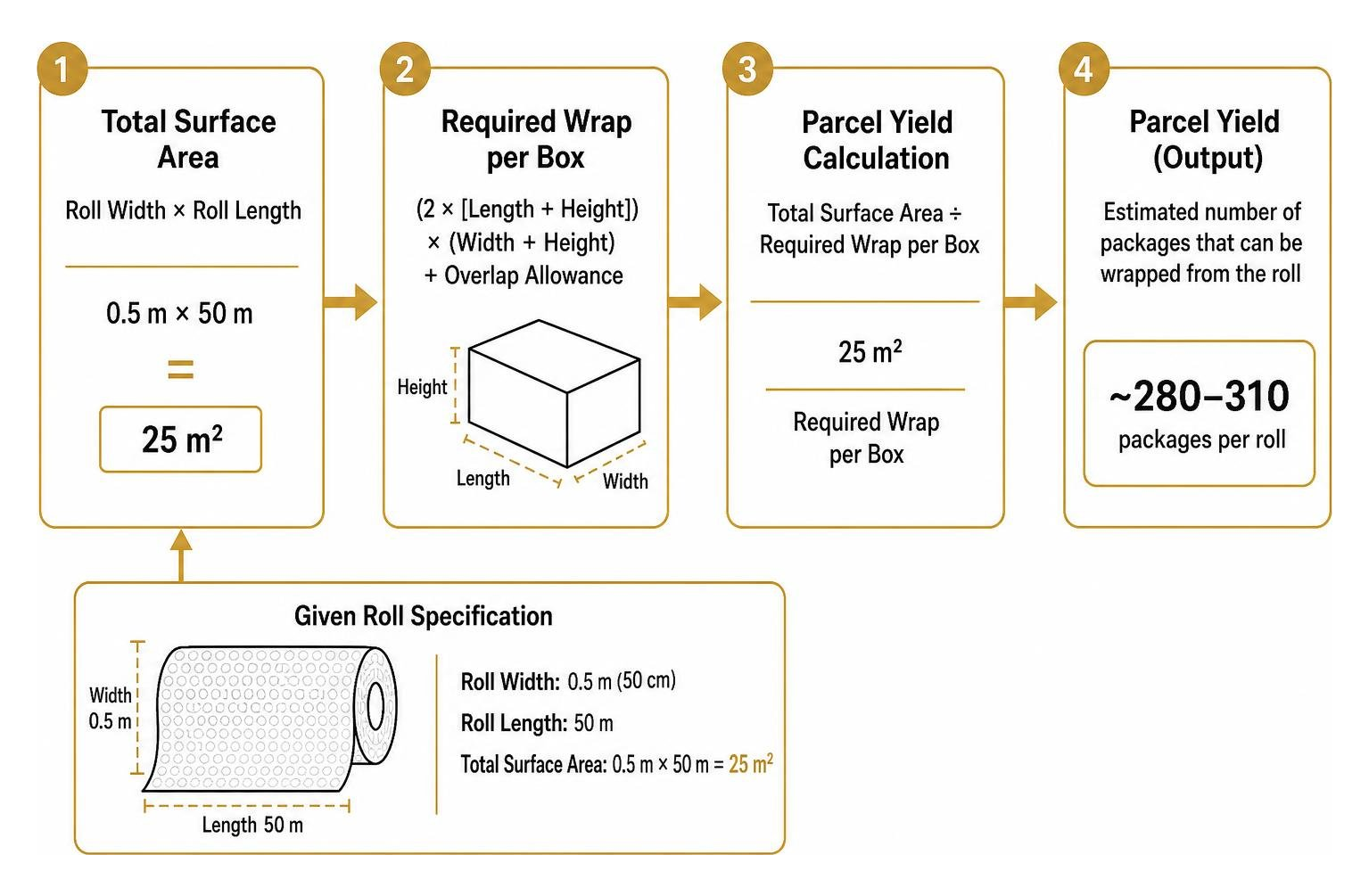
Predicting packaging consumption ensures smooth inventory reordering without stockouts. A standard 50 cm (0.5 meter) wide by 50-meter roll delivers 25 square meters ($25\text{ m}^2$) of total surface area.
To determine parcel yield, calculate the required square footage per box configuration:
Standard Packing Yield Estimates (50 cm × 50 m Roll):
-
Small Jewelry Gift Boxes ($8\times8\times4\text{ cm}$):
- Wrap usage: ~0.08 $\text{m}^2$ per double-wrapped unit.
- Estimated Output: ~280–310 packages per roll.
-
Medium Presentation Boxes ($15\times12\times6\text{ cm}$):
- Wrap usage: ~0.16 $\text{m}^2$ per dual-layer wrap.
- Estimated Output: ~140–155 packages per roll.
-
Large Multi-Item Cartons ($25\times20\times15\text{ cm}$ with void fill):
- Wrap usage: ~0.45 $\text{m}^2$ (cushioning wrap plus internal blocking).
- Estimated Output: ~50–55 packages per roll.
Calculating Cost Per Package with Bubble Wrap 50 Meter Inventory
Evaluating protective packaging costs on a per-unit basis clarifies your true packaging overhead:
- Linear Meter Cost: A 50-meter roll purchased at an average trade price of \$18.00 yields a raw material baseline of \$0.36 per linear meter (or \$0.72 per square meter at 50 cm width).
- Direct Packaging Cost per Small Parcel: Double-wrapping a small presentation box consumes approximately 0.3 linear meters of material, resulting in a direct cushioning cost of ~\$0.11 per parcel.
- Damage Mitigation ROI: Transit damage costs significantly more than packaging supplies once you factor in return shipping fees, item replacement costs, and lost customer goodwill. Allocating \$0.11 to \$0.25 in quality LDPE cushioning per package directly protects fulfillment margins.
Best Practices for Packing Fragile Items and Eco-Friendly Alternatives
Proper wrapping technique ensures maximum shock dissipation during parcel transit while conserving packing material.
The Step-by-Step Protective Wrapping Method
- Orient Bubbles Inward: Always position the bubble side facing the product, with the flat backing film facing outward. The individual air pockets compress directly against the object's surface contours to absorb shock, while the flat exterior film resists external punctures and tears.
- Secure with a Snug Dual Layer: Wrap the item with two continuous layers of small 10 mm bubble wrap. Avoid over-tensioning the wrap, which can compress the air cells before shipment.
- Create Neat Box Folds at Corners: Fold overlapping end flaps cleanly against the base of the item—similar to wrapping a gift—and secure them with clear packaging tape. Structural corners are vulnerable to drop impacts and require full coverage.
- Eliminate Internal Movement (The Box Shake Test): Place the cushioned item inside your corrugated outer carton. Fill any remaining void space with light bubble wrap, paper cushioning, or air pillows. Gently close the box flaps and perform a light shake test: if you detect internal shifting, add cushioning until the contents are immobilized.
Environmental Stewardship and Recyclability
Sustainable packaging practices require understanding how plastic films fit into modern recycling systems:
- Material Classification: Standard bubble wrap is produced from Low-Density Polyethylene (LDPE), classified as Resin Identification Code 4.
- Closed-Loop Recyclability: Clean LDPE film is fully recyclable at designated commercial film collection points and supermarket drop-off locations.
- Recycled Material Options: Using bubble films manufactured with 30% to 75% recycled content reduces reliance on virgin petroleum feedstocks without compromising protective performance.
- Alternative Void-Fill Formulations: For brands seeking non-plastic solutions, embossed kraft paper cushioning, honeycomb die-cut paper wraps, and biodegradable starch loose fill serve as functional alternatives for light-duty void fill.
Frequently Asked Questions About Protective Packaging
How many small boxes can a 50-meter roll of bubble wrap protect?
A standard 50-meter roll with a 50 cm width provides 25 square meters of protective film. For small presentation and jewelry boxes (approx. $8\times8\times4\text{ cm}$), double-wrapping consumes roughly 0.08 square meters per unit. This yields approximately 280 to 310 fully protected packages per roll, factoring in minor trimming allowances.
Is 2-ply LDPE bubble wrap recyclable in standard waste streams?
Yes, 2-ply low-density polyethylene (LDPE) is fully recyclable under Plastic Recycling Code 4. Because lightweight, flexible films can tangle sorting machinery in automated municipal curbside bins, bubble wrap is typically processed through designated store drop-off streams or commercial film recycling centers. Choosing rolls with high post-consumer or post-industrial recycled content further improves circular material use.
What is the difference between 50 GSM and 75-micron bubble wrap?
GSM (grams per square meter) measures the overall areal weight and plastic density of the finished wrap, whereas microns ($\mu\text{m}$) specify the exact thickness of the flat and thermoformed plastic films. A 50 GSM rating represents a standard, lightweight commercial wrap ideal for e-commerce parcels, whereas a 75-micron (75 my) rating denotes a heavier-duty film with higher burst strength and puncture resistance for heavy or sharp-edged products.
Conclusion
Building an efficient fulfillment operation requires matching your protective cushioning to your average box volume and parcel throughput. Choosing a bubble wrap 50 meter format gives packing stations a balanced supply: it delivers substantial wrapping area without taking up excess floor space or letting rolls gather dust.
At Noblepack, we help businesses pair quality presentation packaging with reliable transit protection. Explore our wide selection of protective bubble wrap rolls and packaging essentials to safeguard your products, reduce transit damage, and deliver a clean, professional unboxing experience every time.