
Choose Gold Testers That Match What You Buy and Sell
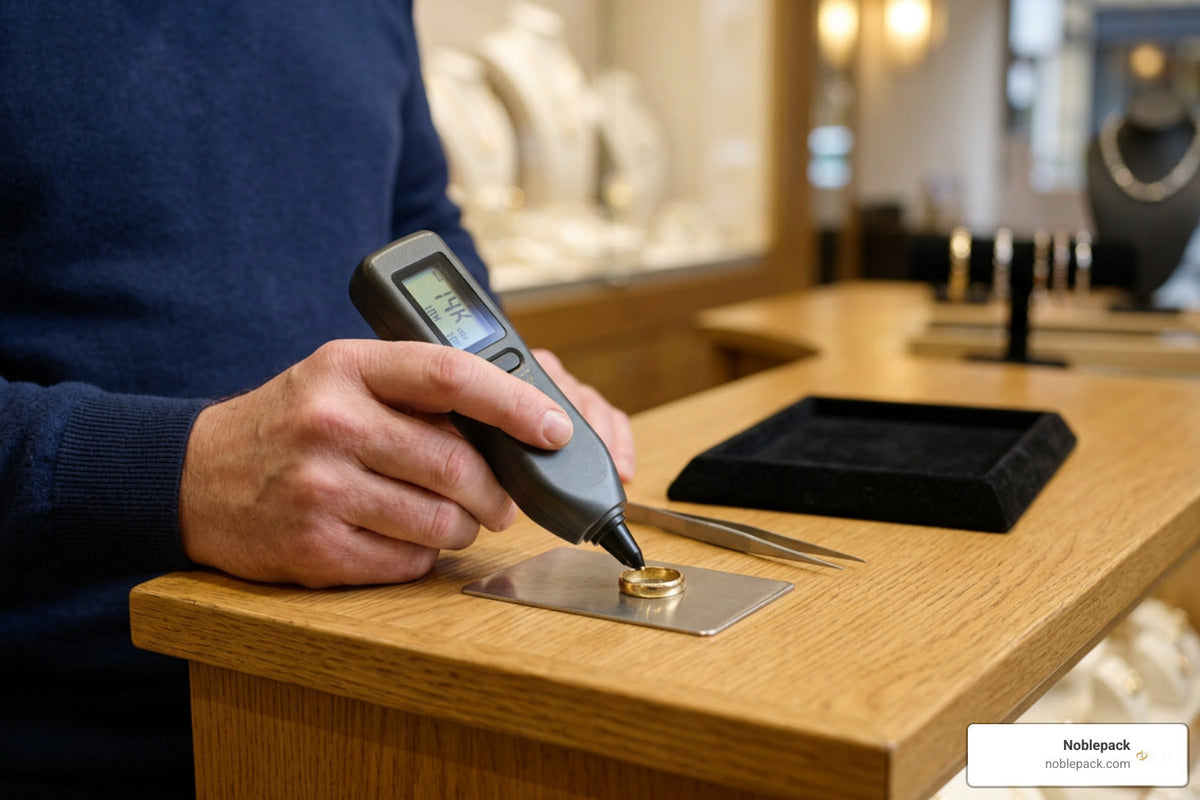
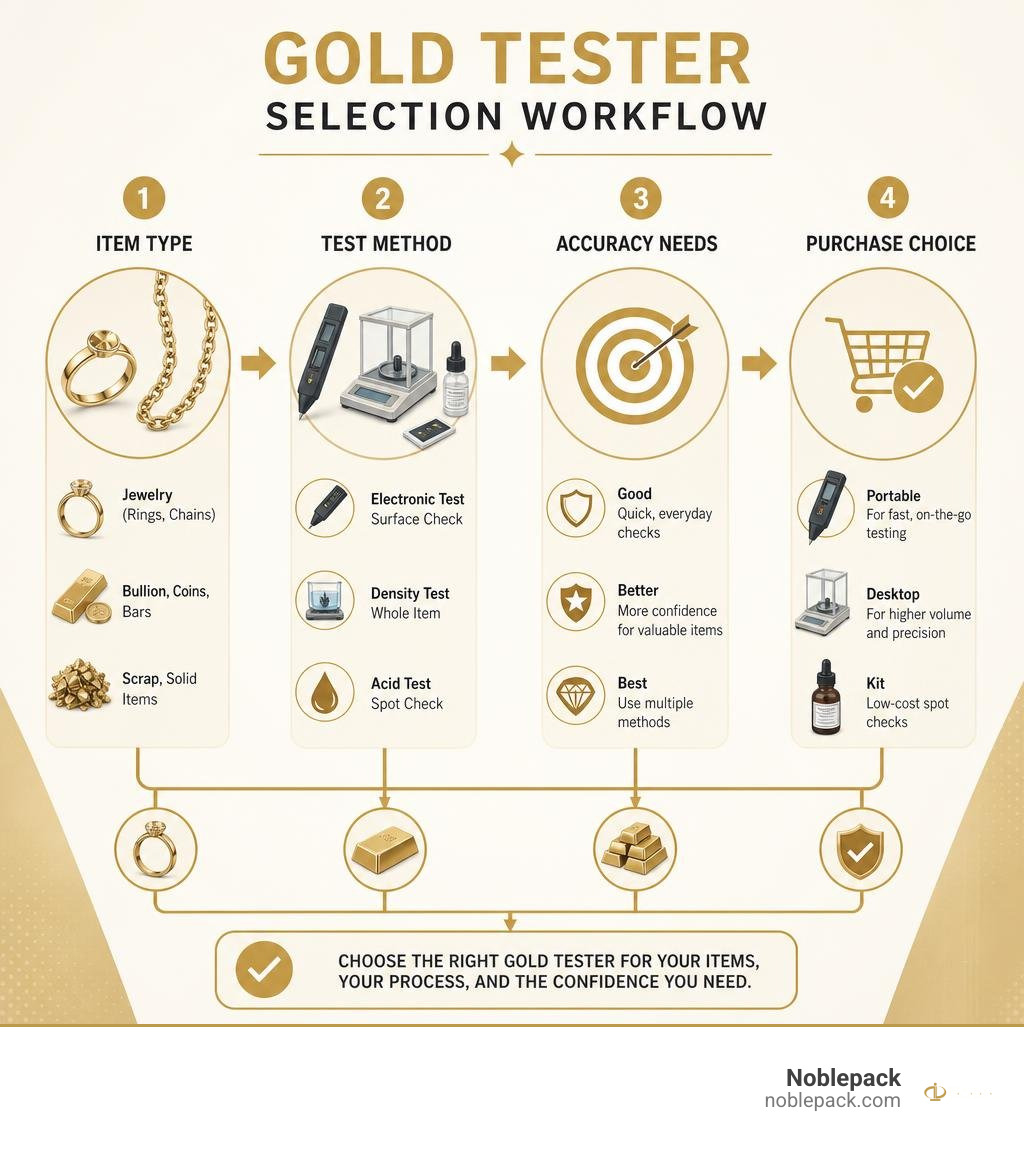
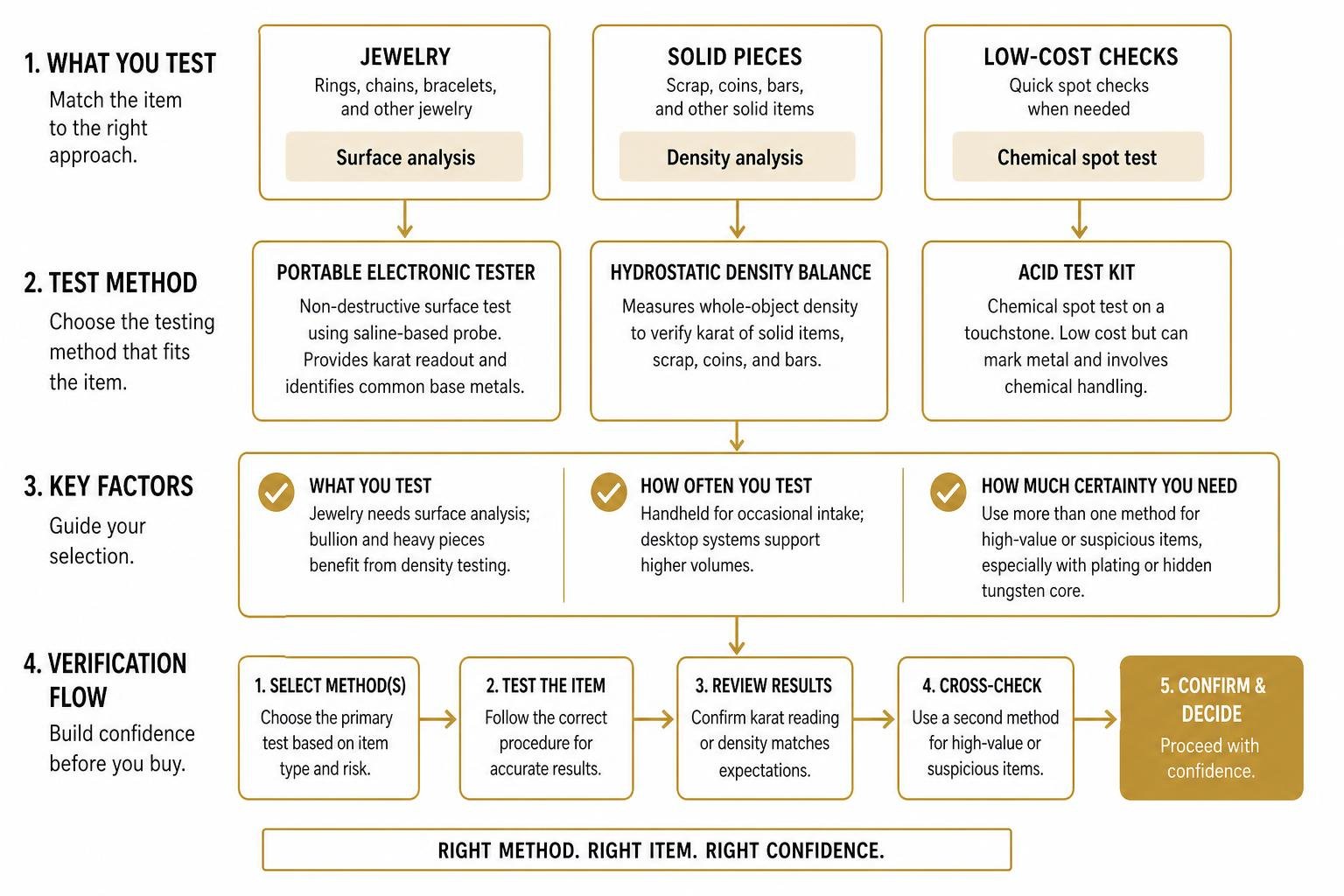
The best gold testers depend on the items you handle. Use a portable electronic tester for fast, non-destructive surface checks on rings, chains, and jewelry. Choose a hydrostatic density balance for solid items, scrap, coins, and bars where you need to check the whole object's density. Keep an acid test kit for low-cost spot checks, but use it carefully because it can mark metal and involves chemical handling.
For a reliable buying decision, focus on three things:
- What you test: Jewelry needs surface analysis; bullion and heavy pieces benefit from density testing.
- How often you test: A handheld model suits occasional intake. A desktop tester supports higher volumes.
- How much certainty you need: Use more than one method for high-value or suspicious items, especially where plating or a hidden tungsten core may be possible.
For jewelry retailers, accurate testing protects both margin and customer trust before an item reaches its final box, display, or shipment. The right tool helps confirm karat value quickly without turning every appraisal into a destructive test.
I'm Dannah Davies, and this guide will help you compare gold testing methods, assess their limits, and choose equipment that fits your operation.
Comparing the Major Types of Gold Testers
Verifying precious metal authenticity requires understanding the underlying physics and chemistry behind each testing method. Whether you are evaluating estate jewelry, buying scrap gold, or taking in high-value bullion, choosing the right testing tool ensures you never overpay for sub-karat alloys or sophisticated fakes.
Portable Electronic Gold Testers
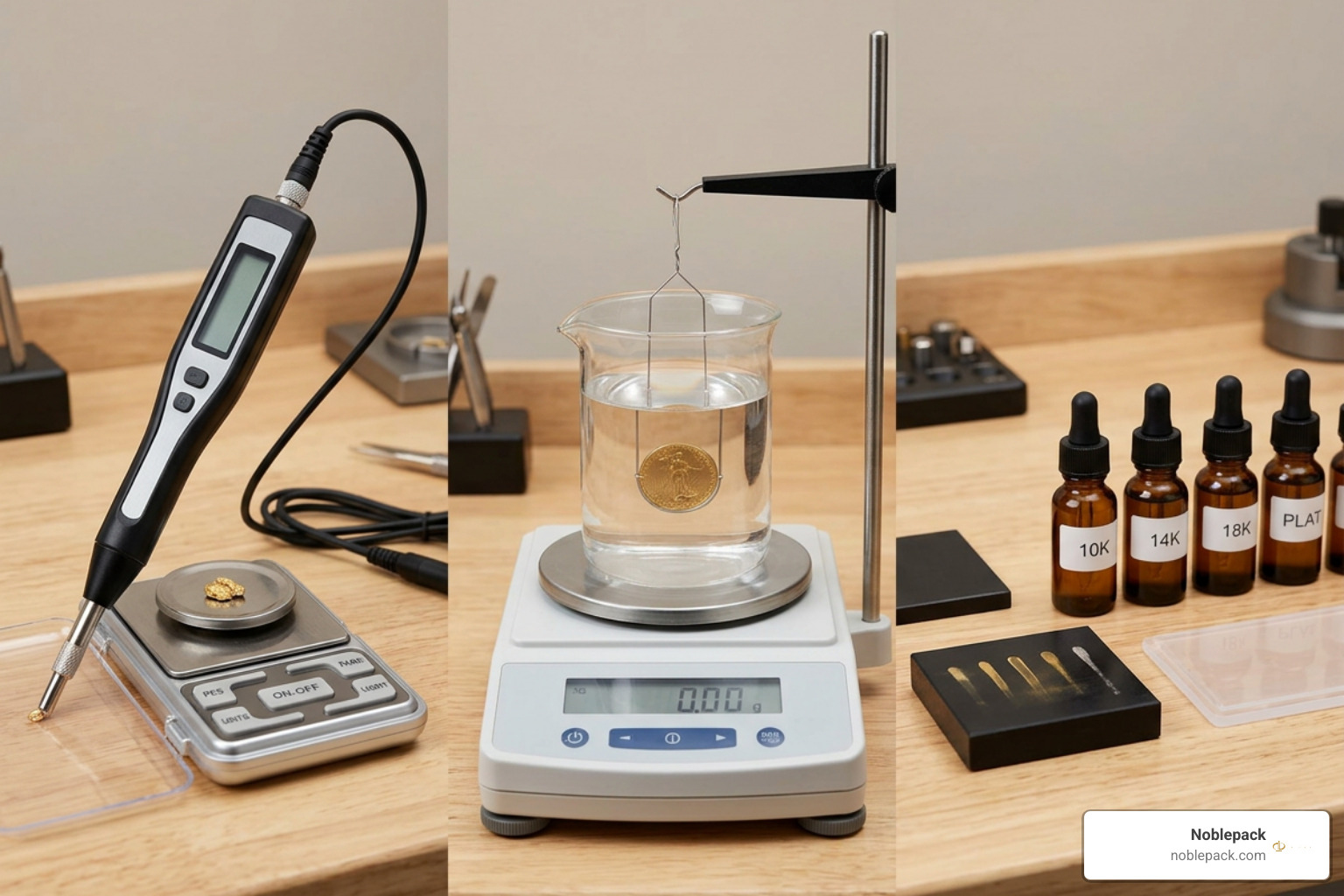
Portable electronic units determine karat value by measuring surface electrical conductivity and electrochemical resistance. Modern digital analyzers utilize specialized saline-based sensor pens or electrolyte test wells to create a closed circuit with the metal.
These devices deliver clear digital readouts across a standard 6K to 24K spectrum (and commonly 8K or 9K to 24K on devices like the AuRACLE and Mizar series). Advanced units also identify platinum and quickly flag non-gold base metals. Because they rely on non-corrosive saline solutions rather than harsh chemicals, they are safe for retail showroom counters, estate auctions, and rapid on-the-go appraisals.
However, electronic pen testers analyze the metal surface. If an item features heavy gold electroplating or flash coating over a brass or silver core, the probe evaluates only that outer microscopic layer unless the surface is properly prepared.
Hydrostatic Density Balances and Specific Gravity Scales
When you need to verify solid metal items—such as cast ingots, cast bars, thick chains, and sovereign coins—hydrostatic density testing provides bulk verification without scratching or damaging the piece.
These instruments operate using Archimedes' principle of buoyancy. The tester weighs the piece first in normal air, then fully submerged in an integrated water tank:
- Air Weight ($W_{\text{air}}$): Measures true total mass.
- Submerged Weight ($W_{\text{water}}$): Measures the upward buoyant force equal to the volume of displaced liquid.
- Specific Gravity Calculation: The internal microprocessor calculates density using the formula: $$\text{Density} = \frac{W_{\text{air}}}{W_{\text{air}} - W_{\text{water}}}$$
Because pure gold has an exact specific gravity of approximately $19.32\text{ g/cm}^3$, and specific karat alloys have known density ranges (such as 14K yellow gold at approximately $12.9\text{ to }14.6\text{ g/cm}^3$), the machine displays the overall purity percentage instantly. High-capacity laboratory devices such as the precious metal tester gk-2000 allow you to check up to 2,100 grams of material without drilling or cutting the sample.
Note: Hydrostatic testing requires solid pieces without hollow cavities or embedded gemstones, as trapped air bubbles or lower-density stones skew the volumetric displacement.
Traditional Acid Kits vs. Modern Digital Analyzers
Traditional testing kits rely on touchstone scratching paired with various concentrations of nitric and hydrochloric acid (aqua regia formulas). The tester rubs the jewelry against a dark slate touchstone to leave a metal streak, then applies karat-specific acids (10K, 14K, 18K, 22K) to observe whether the streak dissolves or changes color.
While acid bottles are inexpensive to purchase initially, they present distinct operational drawbacks:
- Destructive Touchstone Wear: Scratching jewelry across an abrasive stone leaves visible marks, which damages delicate estate pieces, thin prongs, and collectible coins.
- Health and Safety Hazards: Nitric acid off-gasses harmful fumes, causes severe chemical skin burns upon accidental contact, and requires dedicated ventilation and safety neutralizers (baking soda).
- Chemical Degradation: Acid testing solutions degrade rapidly once opened. Heat, air exposure, and ambient light alter their concentration within 3 to 6 months, leading to false readings.
Modern digital analyzers eliminate hazardous acid burns and provide objective numerical readouts instead of subjective color interpretations.
| Feature / Metric | Traditional Acid Kits | Electronic Pen Testers | Hydrostatic Density Scales |
|---|---|---|---|
| Testing Mechanism | Chemical reaction & streak dissolution | Surface electrical conductivity / electrochemical | Specific gravity via Archimedes buoyancy |
| Purity Detection Range | Fixed increments (10K, 14K, 18K, 22K) | Continuous (6K–24K or 8K–24K) | Broad purity % & specific gravity |
| Destructive Impact | Abrasive stone wear & acid etching | Non-destructive (micro-file needed if plated) | 100% Non-destructive (immersion only) |
| Bulk Core Verification | No (surface streak only) | No (surface contact only) | Yes (measures total object density) |
| Safety Concerns | Chemical burns, toxic fumes, acid spills | None (uses safe saline/electrolyte) | None (uses pure distilled water) |
| Average Testing Speed | 1 to 3 minutes | 2 to 15 seconds | 10 to 30 seconds |
Key Factors to Consider Before You Buy a Testing Machine
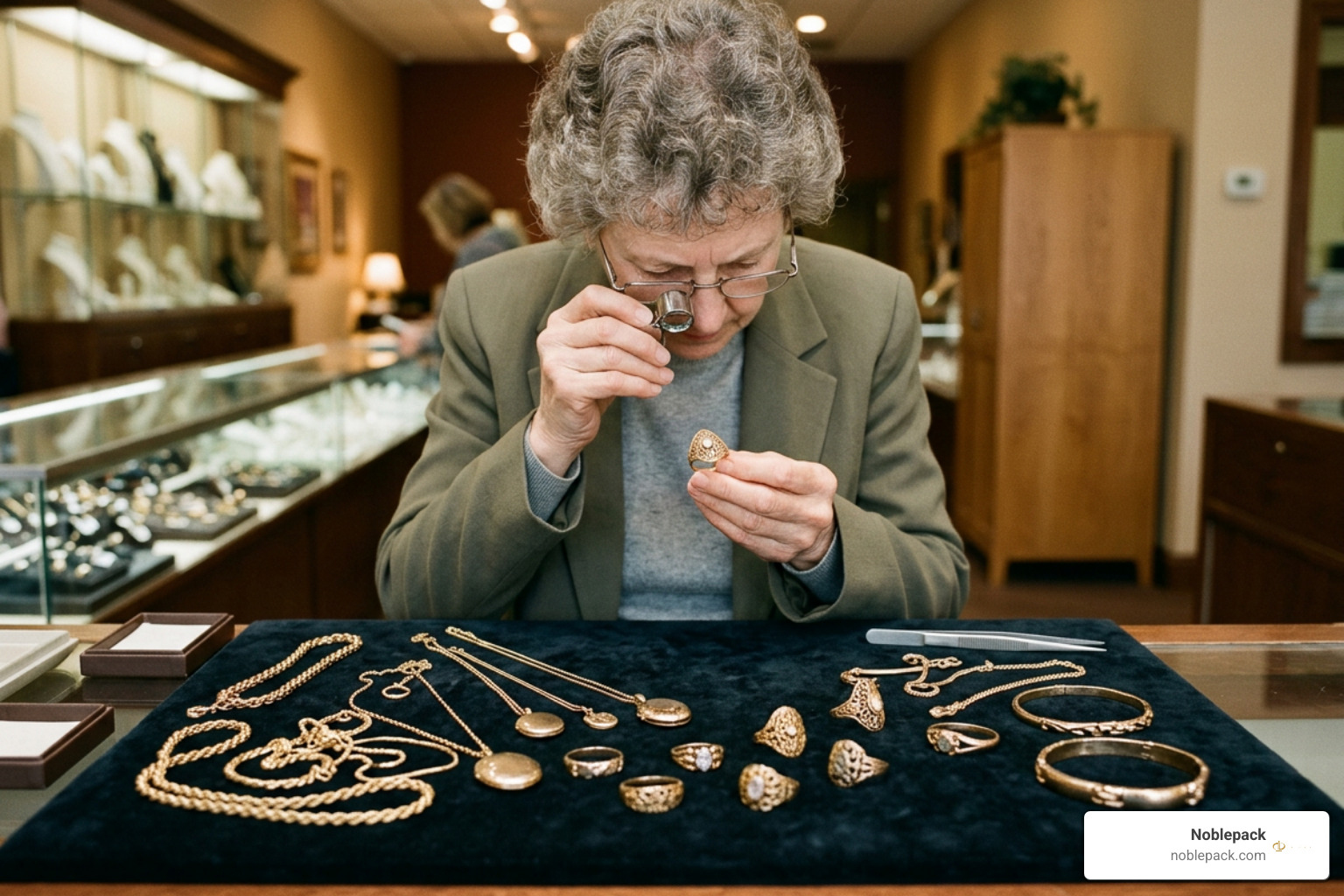
Selecting the right machine requires matching device capabilities with the types of precious metals you process daily.
Testing Range, Karat Accuracy, and Multi-Metal Verification
A versatile testing setup should read alloys ranging from 8K or 9K up to pure 24K bullion. In professional jewelry retail and buying environments, you also encounter white gold, rose gold, green gold alloys, and platinum.
- White Gold and Rhodium: White gold alloys frequently contain 4% to 7% silver or nickel, and are routinely coated in electroplated rhodium to achieve a bright mirror finish. Because rhodium is an unreactive platinum-group metal, electronic testers may register rhodium-plated 14K white gold as high-karat gold or platinum unless the user selects the dedicated white gold mode or tests an inconspicuous, unplated area.
- Gemstone Authentication: While evaluating mounting metals, appraisers frequently inspect stone settings simultaneously. Complementing your workbench with specialized tools such as a culti-diamond tester ensures complete piece assessment. For more on stone testing protocols, you can read our guide on how to determine if lab-grown diamonds pass a diamond tester.
Portability vs. High-Capacity Desktop Operations
Evaluate where your testing takes place:
- Field Appraisals & Mobile Buying: If you frequent estate sales, trade shows, or client residences, battery-operated pen testers running on a 9V alkaline battery provide 10+ hours of continuous mobile operation in a compact carrying case.
- Countertop Processing & High-Volume Intake: High-volume pawn shops, refiners, and busy retail counters benefit from AC-powered desktop density balances with capacities spanning 300g up to 3000g. Desktop systems deliver automated mathematical calculations, eliminating technician math errors when logging large lots of scrap metal.
Best Practices for Operational Accuracy and Maintenance
Even top-tier gold testing instruments deliver inaccurate readings if operated without proper maintenance and surface preparation.
Surface Preparation and Probe Care
Oils, sweat, cosmetics, and atmospheric oxidation form a resistive barrier across jewelry surfaces. Follow standard preparation steps:
- Erase Surface Oxidation: Use a clean gray abrasive eraser to buff the exact contact point until the metal shines brightly.
- Clean Away Debris: Wipe the polished area with a clean micro-fiber cloth or lint-free swab to clear away loose particles.
- Prevent Probe Contamination: Keep the felt tip of saline pen probes clean. Over time, salt crystals form on the tip; wipe the probe gently with a dry, lint-free cloth and immediately replace the protective cap after every testing session to prevent the internal electrolyte from drying out.
How to Calibrate and Maintain Gold Testers
Regular calibration maintains factory-grade accuracy across fluctuating ambient room temperatures:
- Calibration Discs: Calibrate pen analyzers prior to each daily testing session using a genuine 18K yellow gold reference sample disc. Follow the manufacturer calibration routine outlined in the Dymond M24 operation standards to confirm that standard reference points align with internal circuit tolerances.
- Temperature Stability: Operate electronic testers within their recommended temperature range (typically 65°F to 90°F / 18°C to 32°C). Extreme cold or excessive heat alters electrical resistance in the sensors.
- Cross-Verification on High-Value Items: If you encounter an unusual reading on a heavy gold bar or suspect thick gold plating, cross-verify the piece using both surface conductivity and specific gravity density testing. Counterfeits engineered with tungsten cores match the exact density of 24K gold ($19.25\text{ g/cm}^3$ vs $19.32\text{ g/cm}^3$), but tungsten completely fails electronic surface conductivity tests once a micro-file touches the underlying core.
Frequently Asked Questions About Gold Testing Equipment
Can electronic gold testers distinguish between gold-filled and solid gold?
Electronic testers evaluate the metal layer directly in contact with the probe tip. Gold-filled items feature a bonded exterior karat gold layer that constitutes at least 1/20th (5%) of the item's total weight. Because this gold layer is substantially thicker than standard flash electroplating, a gentle surface touch will read as solid gold.
To accurately identify gold-filled items or heavy vermeil, use a jeweler’s micro-file to make a tiny, discreet notch in an inconspicuous area (such as the inside of a ring shank or bottom of a clasp), then place the tester probe directly on the filed notch. If the core is brass, copper, or steel, the analyzer will immediately register non-gold ("NA").
Will non-destructive testing damage delicate vintage jewelry or coins?
No. Saline-based electronic pen testers and hydrostatic density scales are non-destructive. Saline probes use safe, mild electrolytes that wipe clean with a tissue without etching precious alloys. Hydrostatic density balances use pure distilled water immersion, preserving numismatic strike details on rare coins and protecting delicate antique settings.
How often should electronic tester probes and testing fluids be replaced?
Saline pen probes and electrolyte testing solutions have an active shelf life of approximately 6 months once opened. Over time, atmospheric exposure causes the fluid to evaporate and chemical salt concentrations to shift. Replace your pen probe or chemical well solution every 6 months, or sooner if calibration against a known 18K reference disc fails to stabilize.
Conclusion
Investing in reliable testing equipment protects your business from expensive counterfeit scams, prevents margin loss on scrap acquisitions, and ensures full transparency with your retail clientele. Combining a handheld electronic analyzer for quick jewelry intake with a high-precision specific gravity balance for solid bullion creates a dependable appraisal setup.
Once your pieces are authenticated and appraised, presenting them in premium, elegant packaging elevates your brand and reinforces customer trust. We invite you to browse high-precision gold testers and explore our complete selection of professional jewelry boxes, showcase displays, and packaging supplies.