
What Are Jewelry Packaging Inserts — and Why Do They Matter?
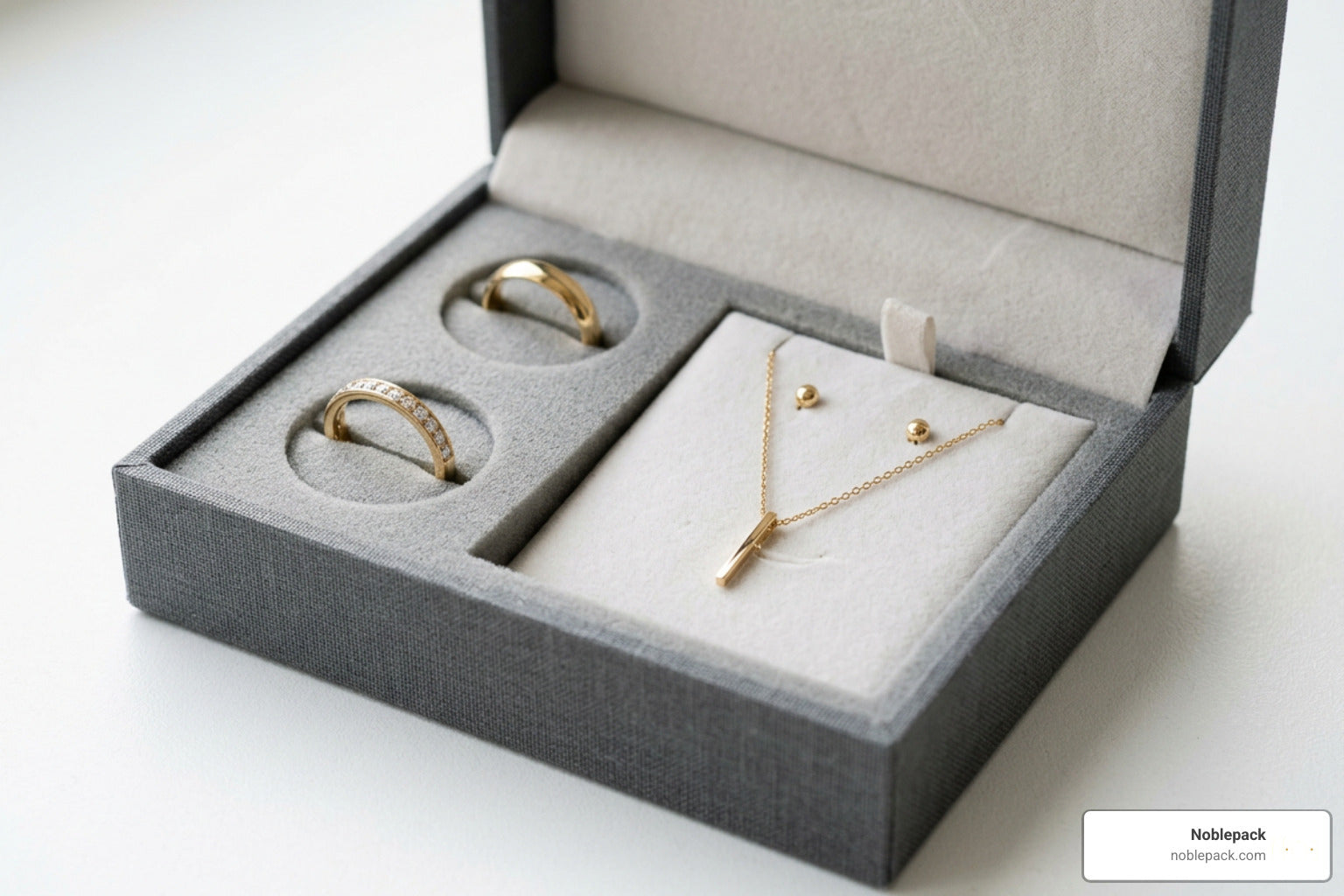
Jewelry packaging inserts are the shaped pads, foam trays, and fabric-lined platforms that sit inside a jewelry box to hold pieces securely in place. They are the difference between a ring rattling around in an empty box and a ring that arrives looking like it belongs in a boutique window.
Here is a quick overview of the most common types:
| Insert Type | Best For | Key Benefit |
|---|---|---|
| EVA foam | Rings, earrings, sets | Firm, durable, holds shape |
| PU foam | Budget lines | Soft, flexible, cost-effective |
| Velvet-lined foam | Luxury presentation | Premium look and feel |
| Cardboard / peachboard | Eco-friendly or budget | Lightweight, recyclable |
| Microfiber / suede | High-end gifting | Soft touch, scratch-free |
The stakes are higher than most retailers expect. A 2023 study found that 40% of consumers said they would share a product image on social media if it came in premium or gift-like packaging. That is free marketing — or a missed opportunity — decided in seconds.
And the cost of not investing is real. When jewelry arrives loose in a generic box, scratched or tangled, that single moment can undo months of brand-building. Swapping a basic cotton filler for a custom foam-and-velvet insert has been shown to increase unboxing satisfaction scores by 30–40%.
Whether you sell on Etsy, run a boutique, or ship wholesale orders, the insert inside your box is doing more work than it looks like.
Why Jewelry Packaging Inserts Matter: Protection, Presentation, and Brand Value
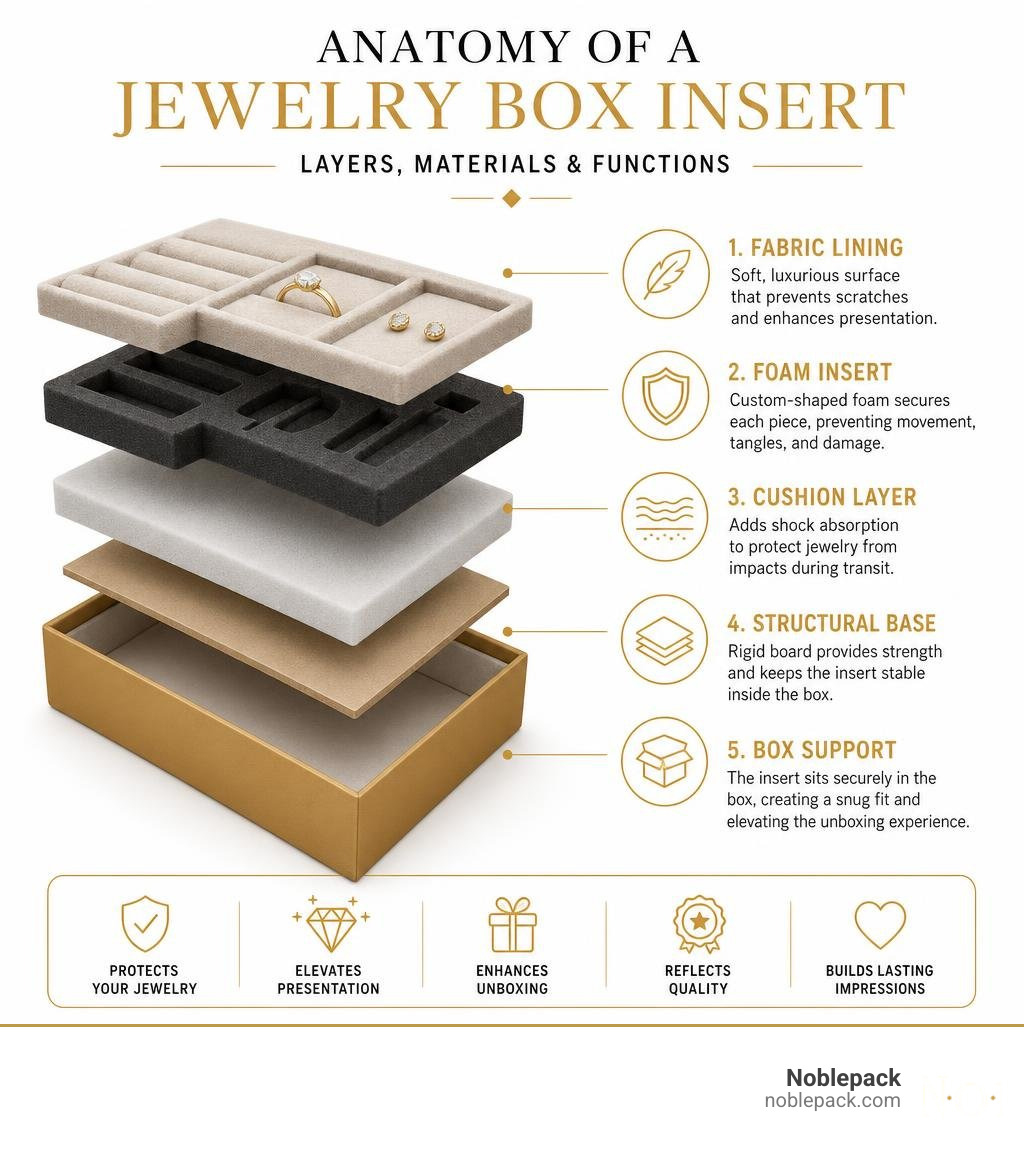
When we design a beautiful piece of jewelry, we spend weeks, sometimes months, perfecting the curves, the setting, and the polish. But once that piece leaves our hands, it enters the chaotic world of fulfillment centers, delivery trucks, and local couriers. This is where high-quality jewelry packaging inserts step up as the unsung heroes of your business.
First and foremost, inserts provide critical transit security. Without a custom-fit barrier, delicate chains tangle, earrings scratch against their own backings, and soft metals like sterling silver or high-karat gold rub together. By utilizing precision-cut cavities, we eliminate friction and absorb the inevitable shocks of shipping. If you want to understand how this fits into your broader shipping strategy, take a look at our comprehensive guide on jewelry shipping packaging.
Beyond survival, there is the psychological impact of the "premium reveal." When a customer lifts the lid of a box, they should not hear the cheap, hollow sound of loose plastic. Instead, they should see their purchase perfectly centered, catching the light like a museum exhibit. This level of presentation elevates different types of packaging from simple cardboard containers to luxury keepsakes.
A well-designed insert acts as a silent salesperson. It signals that you value your craft, respect your customer's investment, and pay attention to the smallest details.
Main Types of Jewelry Box Inserts and Materials
Choosing the right material is a balancing act between budget, aesthetic goals, and protective requirements. Let us break down how the most common materials stack up against each other in the retail landscape of July 2026.
| Material | Durability | Aesthetic Appeal | Relative Cost | Environmental Impact |
|---|---|---|---|---|
| EVA Foam | High | Medium-High | Moderate | Low (unless recycled) |
| PU Foam | Medium | Low-Medium | Low | Low |
| Velvet-Coated Foam | High | High | Moderate-High | Medium |
| Cardboard / Peachboard | Medium | Medium | Low | High (highly recyclable) |
| Suede / Microfiber | High | High | High | Medium |
EVA Foam (Ethylene-Vinyl Acetate)
EVA is a dense, closed-cell foam with a smooth, rubbery feel. It is incredibly durable and holds its shape perfectly, making it the gold standard for heavy or high-end jewelry. Because it can be cut with extreme precision, it is ideal for holding heavy rings or complex multi-piece sets without sagging.
PU Foam (Polyurethane)
PU foam is the soft, spongy, open-cell foam you often find in budget packaging. While it is highly cost-effective and offers decent cushioning, it lacks the premium weight and structural refinement of EVA. It is best suited for lightweight, casual jewelry or as a protective top pad.
Velvet and Fabric-Covered Inserts
Laminating a layer of plush velvet, velour, or microfiber over a foam base gives you the best of both worlds: the structural integrity of foam combined with a luxurious, soft-touch surface. This classic pairing is a staple of high-end collections, offering an instantly recognizable touch of elegance.
Cardboard and Peachboard
For brands prioritizing a minimalist or natural aesthetic, structured cardboard and peachboard offer a highly clean, modern look. Peachboard inserts are stiff, lightweight platforms that are typically wrapped in high-quality textured paper. They are available in standard colors like black and white and are designed to sit perfectly over traditional cotton fill. These pre-cut board options are excellent for saving assembly time while maintaining a professional presentation.
Choosing the Right Jewelry Packaging Inserts for Different Gemstones
Not all jewelry materials are created equal, and neither are the inserts that hold them. When dealing with delicate gemstones or sensitive metals, chemical compatibility is just as important as physical cushioning.
Soft stones like pearls, opals, and turquoise are highly susceptible to scratches. For these, abrasive or stiff fibers are out of the question. You should opt for ultra-soft microfiber, silk, or high-grade velvet overlays.
Furthermore, precious metals are highly sensitive to industrial chemicals. Many standard packaging foams and adhesives release trace amounts of sulfur or acidic byproducts over time. When exposed to air and moisture, these chemicals accelerate tarnishing on silver and low-karat gold.
To safeguard your inventory, always specify that your inserts must be made from tarnish-tested, acid-free, and pH-neutral materials. This is a hallmark of true luxury jewelry packaging, ensuring your pieces remain bright, shiny, and ready to wear even after months in storage.
How to Match Inserts to Specific Jewelry Types
An insert that is perfect for a dainty ring will fail miserably when holding a heavy statement necklace. To design packaging that looks intentional, we must tailor the insert's physical architecture to the specific jewelry piece it holds.

To learn more about matching your packaging to your product catalog, check out our guide on jewelry box packaging and read up on the fundamentals of how to pack jewelry safely.
Ring and Earring Insert Layouts
Rings and earrings require precise, snug layouts to prevent them from tilting or falling out of display alignment during transit.
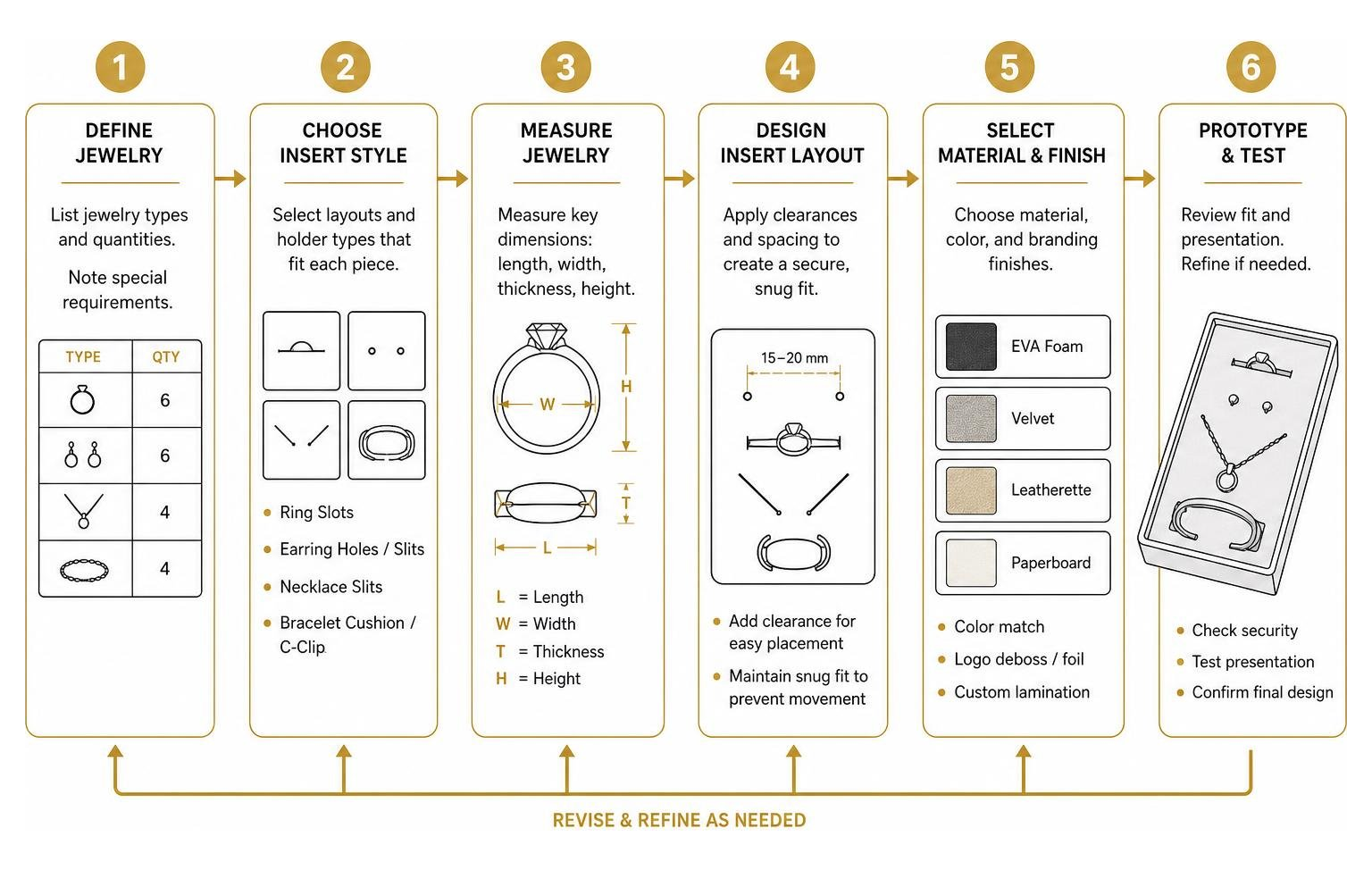
- Ring Slots: The standard approach is a single or double horizontal slit cut into a dense EVA foam base. For a more premium presentation, use a "H-slot" or a "U-shaped" cut. These designs hold the ring band firmly from the sides, keeping the head and center stone upright and front-facing.
- Earring Post Holes: Earring inserts typically feature small, pierced post holes (apertures). For stud earrings, a pair of simple holes spaced 15–20mm apart is ideal. For drop or hoop earrings, vertical slits or top-hanging notches are necessary to let the pieces dangle naturally without hitting the bottom of the box.
Necklace and Bracelet Insert Layouts
Necklaces and bracelets present a different challenge: tangling and shifting.
- Necklace Tension Slits: To keep chains from turning into a knotted nightmare, inserts should feature diagonal tension slits at the top corners. The chain is slipped through these slits and secured behind the insert card, keeping the pendant centered and the chain taut.
- Bracelet Cushions and C-Clips: Soft, stuffed fabric pillows are excellent for bangles and flexible chain bracelets, giving them a three-dimensional, realistic shape. For rigid cuffs or high-end watches, a plastic or metal-reinforced "C-clip" wrapped in suede keeps the piece perfectly upright and centered in the box.
Design, Customization, and Branding Strategies
Your packaging is the first physical touchpoint your customer has with your brand. It should tell your story before they even lay eyes on the jewelry itself.
By coordinating the colors, textures, and finishes of your inserts with your outer boxes, you create a cohesive visual identity. For example, matching your insert lining to a specific Pantone shade of your brand's color palette creates an instant sense of recognition.
To get your creative juices flowing, explore our curated lists of custom jewelry packaging solutions and browse through these creative jewelry packaging ideas.
Designing Custom Jewelry Packaging Inserts for Your Brand
If you are a growing business, upgrading to custom-designed inserts is one of the most cost-effective ways to boost your perceived value.
There are several ways to apply your branding directly to your inserts:
- Logo Debossing: This technique presses your logo into the surface of a foam or leatherette insert, creating a subtle, high-end, recessed mark that does not distract from the jewelry.
- Hot Foil Stamping: Perfect for velvet or paperboard inserts, foil stamping applies a thin layer of metallic gold, silver, or rose gold foil to your logo, catching the light beautifully when the box is opened.
- Velvet Lamination: You can laminate custom-colored fabrics or custom-printed silk-touch papers over a rigid foam base to match your exact brand aesthetic.
For small businesses, this level of detail can set you apart from mass-market competitors. Read our targeted guides on small business jewelry packaging and jewelry packaging ideas for small business to see how you can implement these strategies on a realistic budget to elevate every unboxing experience and make your pieces shine.
Sourcing, Costs, and Production Considerations
When you are ready to move from DIY solutions to professional manufacturing, there are a few technical and financial realities to keep in mind.
First, consider the Minimum Order Quantity (MOQ). For fully custom, CNC-die-cut foam inserts, manufacturers typically require an MOQ starting around 500 to 1,000 units. If you are not ready for those volumes, starting with standard, pre-cut peachboard or foam inserts is a smart way to keep upfront costs low.
Second, factor in tooling and mold costs. Creating a custom die-cut mold for a unique jewelry shape usually involves a one-time tooling fee ranging from $150 to $400. However, once this mold is created, it is amortized over your production runs, bringing your per-unit cost down significantly.
Always request a physical prototype before approving a bulk production run. A handmade sample typically takes 7 to 10 days to produce, but it is the only way to verify that your jewelry fits snugly and that the insert sits 1-2mm below the rim of the box (which is crucial for magnetic closures to shut properly).
The Eco-Friendly Shift
Sustainability is no longer a niche preference; it is a business imperative. In 2026, 66% of global consumers consider environmental impact when making a purchase.
To meet this demand, look for FSC-certified paperboard inserts, which guarantee that the wood pulp used comes from responsibly managed forests. Additionally, innovative materials like biodegradable mycelium (mushroom-based) inserts and recycled ocean plastics are gaining rapid popularity, proving that you do not have to sacrifice structural integrity to protect the planet.
Frequently Asked Questions about Jewelry Box Inserts
Will foam inserts cause my silver or gold jewelry to tarnish?
Not if you use the right materials. Cheap, industrial-grade utility foams can release acidic chemicals or sulfur gases (a process called off-gassing) that accelerate tarnishing. However, professional jewelry packaging inserts are specifically manufactured using acid-free, pH-neutral, and tarnish-tested materials that are completely safe for long-term storage of precious metals.
What is the difference between EVA foam and PU foam for inserts?
EVA foam is a dense, closed-cell foam with a smooth, rubbery, premium feel. It holds its shape perfectly and is highly durable, making it ideal for luxury presentation. PU foam is a soft, open-cell, spongy foam. While PU is highly cost-effective and provides excellent shock absorption for shipping, it looks less refined and is generally used for budget lines or as a protective top layer.
Can I design eco-friendly inserts that are still strong and protective?
Absolutely. Modern eco-friendly inserts made from dense, recycled cardboard, molded sugarcane pulp, or biodegradable starches offer incredible structural integrity. They can be precision-cut just like foam, providing a snug, secure fit for transit while remaining fully recyclable or compostable.
Conclusion
At the end of the day, your jewelry packaging is a stage, and the insert is what keeps your star performer standing in the spotlight. Investing in high-quality, custom-fit jewelry packaging inserts ensures that your pieces arrive safely, look stunning, and leave a lasting impression on your customers.
Here at Noblepack, we specialize in helping jewelry brands of all sizes find their perfect packaging match. From our premium, sophisticated collections like the Sardinia line to our incredible, wallet-friendly clearance deals on discontinued luxury items, we have everything you need to elevate your brand.
Ready to make your pieces shine? Explore our full range of jewelry packaging solutions today to find the perfect fit for your collection!