

Types and Formats of Wrapping Paper
Choosing the right format of gift wrap shapes your workflow, storage space, and presentation quality. Retail operations and busy event planners require efficiency, whereas boutique packaging often prioritizes precision sizing. Gift wrap typically comes in continuous rolls or flat pre-cut sheets, each designed with specific applications, core sizes, and backing features in mind.
Standard rolls range widely in square footage—from compact 15 to 20 sq. ft. rolls for light home use up to massive 150 to 180 sq. ft. commercial rolls. Standard commercial rolls generally measure 30 inches wide on a 2-inch core, while pre-cut flat sheets usually measure 20" x 28" (or metric equivalents like 61 x 79 cm). Many modern rolls also incorporate printed cutting grid backings on the reverse side, functioning like built-in guides to ensure straight lines and eliminate material waste.
| Format | Common Dimensions | Best Application | Storage & Handling |
|---|---|---|---|
| Standard Roll | 30" wide × 8' to 30' long (15–75 sq. ft.) | Medium-to-large parcels, general retail | Requires vertical or horizontal roll racks |
| Commercial Jumbo Roll | 30" wide × 100'+ long (90–180 sq. ft.) | High-volume department wrapping, odd shapes | Heavy; requires sturdy rolling dispensers |
| Flat Sheets (Packs) | 20" × 28" (approx. 50 × 70 cm) | Small-to-medium rigid boxes, jewelry packaging | Stores flat in shallow drawers without curling |
| Mini Rolls | 24" to 29.25" wide × 7.15' long | Crafting, small gift items, seasonal kits | Compact; easily organized in tabletop bins |
Continuous Rolls and Pre-Cut Flat Sheets
Continuous rolls provide complete flexibility for gifts of unpredictable shapes and sizes. When wrapping larger boxed items, a long roll prevents awkward seam placement. However, continuous rolls can curl tightly at the end of the roll, making handling delicate items tricky without weighted dispensers or sharp wrap cutters.
Pre-cut flat sheets eliminate edge curling entirely. Flat sheets are ideal for standard jewelry boxes, perfume cartons, and luxury apparel boxes. Because flat sheets lie completely flat, boutique staff can wrap smaller boxes quickly without wrangling a bulky cylinder. They also slide neatly into shallow storage drawers, keeping your counter organized.
Reversible and Double-Sided Patterns
Reversible wrapping paper features complementary or contrasting designs on each side. This format lets you create styling accents like the cuff fold—where the top edge of the paper is folded downward to expose the reverse pattern before securing the package.
Using classic patterns like Solid Color Pinstripe Wrapping Paper provides dual-theme styling options that suit everyday luxury gifts and formal corporate events alike. Reversible styles essentially double your design inventory without requiring extra shelf storage.
Custom and Personalized Print Options
Custom-printed gift wrap allows brands and individuals to transform simple packaging into branded storytelling. Whether integrating corporate logos, bespoke artwork, or photography, digital on-demand printing supports low minimum orders.
When preparing files for personalized wrap:
- Resolution: Maintain a minimum digital print resolution of 200 dpi at 100% scale to prevent pixelation.
- Color Profiles: Design in an sRGB color space (such as sRGB IEC61966-2.1) or CMYK depending on printer specifications, ensuring brand colors translate cleanly from screen to print.
- Pattern Alignment: Build a seamless repeating tile and verify bleed buffers along outer margins so edge trims do not leave unprinted white lines.
Paper Materials, Finishes, and Weight Standards
The tactile feel of wrapping paper influences a customer's perception of quality before they ever reach the product inside. Paper thickness, coating, and composition dictate whether a fold holds a crisp edge or tears under light tension. Selecting the proper grade ensures a seamless unboxing experience that reflects the care put into selecting the gift itself.
Understanding GSM and Paper Durability
Paper density and weight are measured globally as grammage in Grams per Square Meter (GSM), or in pounds (lb) across North American paper classifications:
- Lightweight Papers (50–70 GSM): Flimsy and prone to tearing along sharp box corners. They often lack opacity, allowing printed retail packaging graphics, barcodes, or labels to show through the paper. While economical for high-volume, low-cost packing, they require delicate handling.
- Mid-to-Heavyweight Papers (80–100 GSM / 60 lb Stock): The sweet spot for luxury retail wrapping. A 90 GSM matte stock or 60 lb coated gloss stock provides structural rigidity, crisp creases, and full opacity without cracking along fold lines. This weight holds double-sided tape cleanly and delivers sharp, tailored edges.
- Heavyweight Papers & Board (120+ GSM): Extremely durable and opaque, but can be overly stiff for intricate corner folds on small jewelry boxes. Heavyweight sheets often require bone folders to score sharp lines and heavy-duty double-sided tape to prevent seams from popping open.
Specialty Finishes and Luxury Wrapping Paper Styles
Different paper coatings and manufacturing finishes achieve distinct visual and tactile results:
- Matte Paper: Offers a smooth, non-reflective surface that showcases fine typography, delicate illustrations, and subtle artistic patterns without studio glare. Matte finishes are especially favored in modern, minimalist packaging.
- High-Gloss Paper: Maximizes color vibrancy and contrast, giving festive and branded patterns an eye-catching, polished sheen that repels minor smudges.
- Foil and Holographic Stocks: Incorporate metallic stamping or micro-embossed diffraction gratings. Options like Jewellers Wrapping Paper Q and shimmering Hologram Wrapping Paper catch ambient light, adding a high-impact luxury presence beneath retail display lighting.
- Embossed and Textured Papers: Feature tactile raised patterns, linen weaves, or ribbed textures that add an unmistakable sensory dimension to boutique packages.
Matching Gift Wrap to Events and Recipients
Aligning gift wrap style with the occasion and recipient creates an intentional, polished presentation.
Choosing the Right Wrapping Paper for Special Occasions
Different milestones call for dedicated aesthetic approaches:
- Holiday Presentations: Festive celebrations benefit from classic geometric motifs, rich jewel tones, and seasonal prints like Xmas Circles Printed Wrapping Paper.
- Weddings and Anniversaries: Subtle, sophisticated textures such as White on White Floral Wrapping Paper offer an understated, romantic presentation that pairs naturally with satin ribbons.
- Birthdays and Celebrations: Energetic palettes, colorful dots, and expressive patterns deliver immediate visual excitement for all ages.
Fine Jewelry and Boutique Presentation
Small-scale luxury items require tailored wrapping practices. Bulky papers can overwhelm delicate rigid jewelry boxes, making corners look rounded and sloppy.

For fine jewelry, choose a high-density, lightweight paper that forms sharp, geometric folds. Classic patterns like Gold Metallic Bows on White Jewellers Wrapping Paper add elegance to ring, earring, and necklace boxes. Conversely, fun retail lines or whimsical jewelry collections can feature expressive graphics like Vibrant Cartoon Printed Wrapping Paper to delight younger recipients.
Sustainability, Essential Accessories, and Pro Techniques
Eco-friendly packaging practices are an increasingly important consideration for both retailers and consumers. Traditional wraps featuring plastic lamination, metallic foils, synthetic glitter, or heavy solvent coatings cannot be recycled in municipal paper streams. Adopting sustainable methods allows businesses to minimize their environmental footprint while maintaining an exquisite presentation.
To support sustainable gift presentation:
- Choose Uncoated Stocks: Natural kraft papers and 100% recyclable matte paper printed with water-based vegetable or pigment inks can enter standard curbside recycling bins.
- Perform the Scrunch Test: Crumple the paper into a tight ball. If it stays balled up, it is primarily cellulose paper and widely recyclable. If it springs open, it likely contains synthetic plastic film or foil layers that belong in general waste.
- Use Coordinated, Reusable Accessories: Pair recyclable paper with natural cotton cords, jute twine, grosgrain ribbons, or paper-based gift tags. Avoid standard plastic tape when possible by opting for paper tape or adhesive wax seals for a vintage touch.
- Master Precision Tools: Keep cutting lines clean using precision sliding wrap cutters or rotary blades rather than dull scissors to eliminate jagged edges. Employ a bone folder to crease crisp, razor-sharp edges along box perimeter folds.
- Organize Wrap Storage: Store continuous rolls vertically in dedicated storage tubes or horizontally on suspended dowel racks away from humidity and direct sunlight to prevent edge crushing, warping, and sun fading.
Frequently Asked Questions About Wrapping Paper
What does GSM mean when choosing gift wrap?
GSM stands for "Grams per Square Meter," the international standard measuring paper density and weight based on a 1 square meter sheet. For gift wrapping, stocks between 80 and 100 GSM offer the best balance of tear resistance, opacity, and foldability.
Which types of gift wrap are recyclable?
Plain, uncoated, and matte wrapping papers printed with non-toxic, water-based inks are widely recyclable. Wrapping paper that incorporates micro-glitter, metallic plastic film, foil stamping, or heavy synthetic lamination cannot be processed by standard paper recycling facilities and should be disposed of in general waste.
How do I calculate the amount of paper needed for a box?
To measure paper coverage accurately:
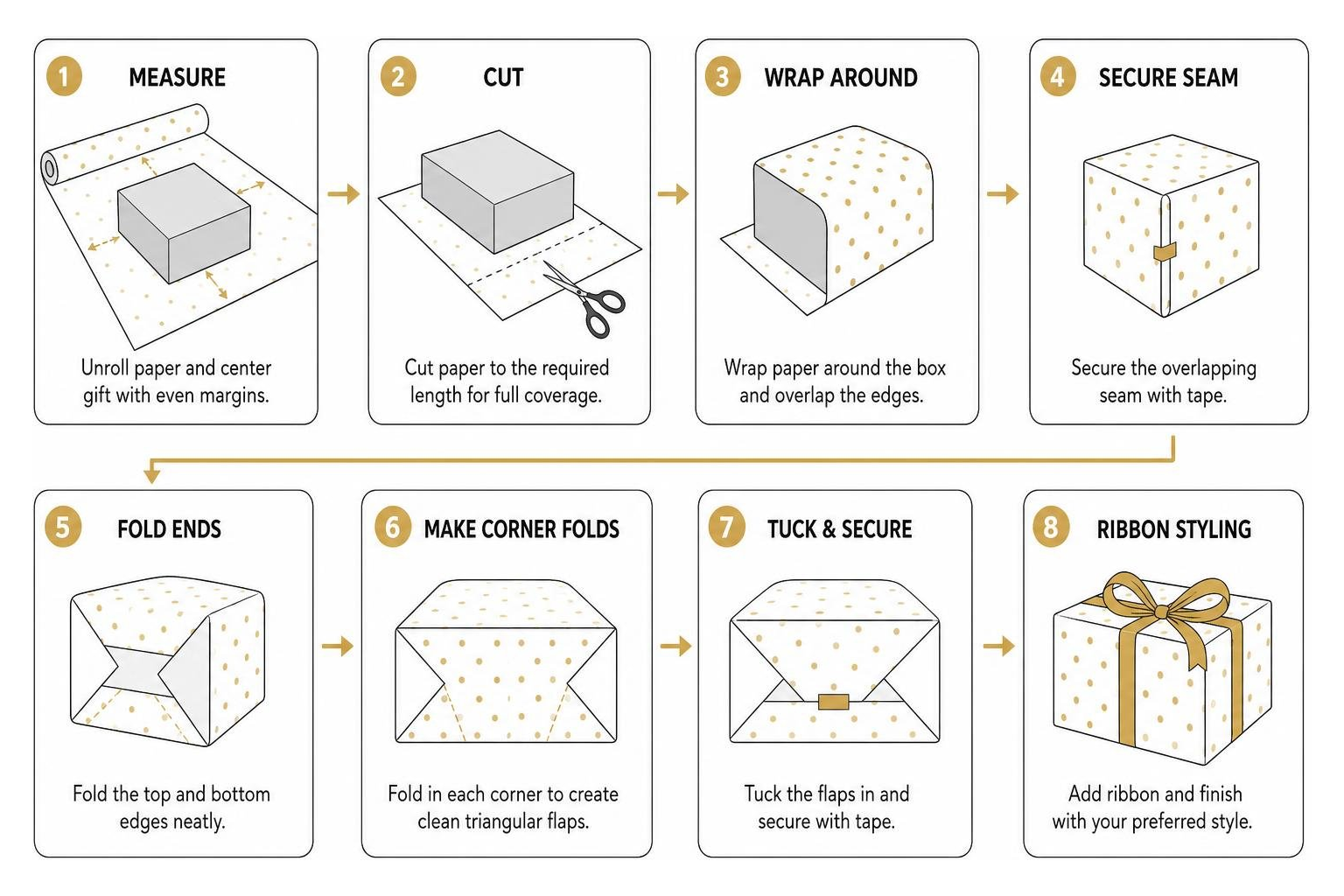
- Width: Cut the paper wide enough to wrap around the entire circumference of the box with an overlap of roughly 2 inches (5 cm).
- Length/Side Flaps: The paper extending from each side of the box should measure roughly two-thirds of the box's depth, allowing the flaps to fold flat across the sides without excess bulk.
Conclusion
A well-executed gift wrapping strategy elevates unboxing from a routine task into a memorable brand experience. By pairing appropriate paper weights, functional formats, and tailored aesthetic designs with crisp folding techniques, businesses and individuals can present every gift with confidence.
Upgrade your retail presentation and explore the complete wrapping paper collection to discover professional-grade wraps, matching jewelry boxes, and finishing accessories designed to make every parcel stand out.