
What Is 18 Gauge Jewelry Wire Best For?
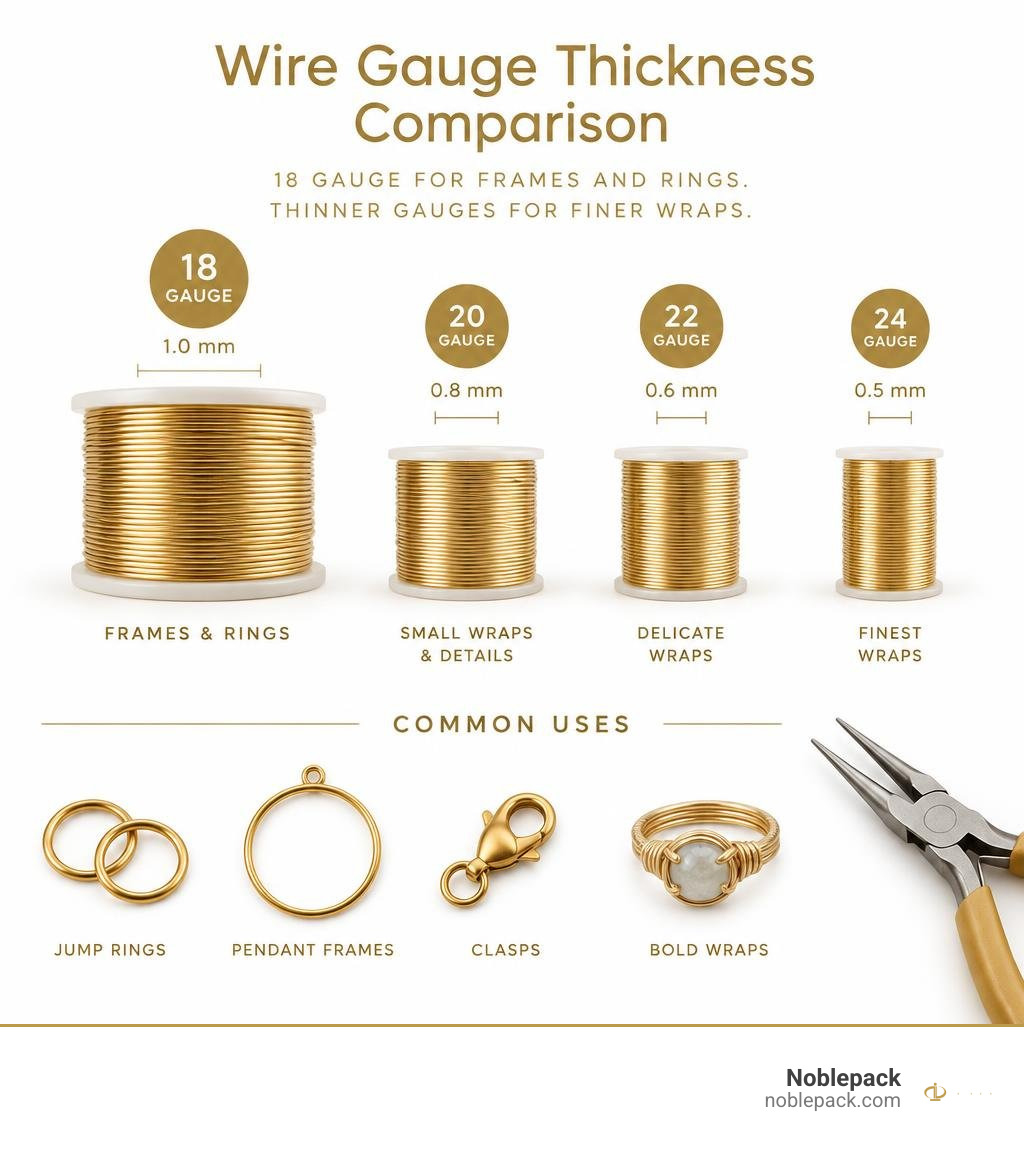
18 gauge jewelry wire is about 1.0 mm thick. It is a good choice for sturdy jump rings, pendant frames, clasps, and bold wire-wrapped designs. Choose dead soft wire when you need easy bends, or half-hard wire when the finished piece needs to hold its shape.
Gauge numbers run backward: 18 gauge is thicker than 20, 22, or 24 gauge. That makes it useful for structure, but often too thick for small bead holes or delicate wraps. The metal and wire shape matter, too, and this guide will help you choose both.
I'm Dannah Davies, and I'll walk you through the choices that matter most for your project.
Understanding 18 Gauge Jewelry Wire: Profiles and Temper
To get the most out of your metalwork, understanding the physical structure of the wire is essential. In the American Wire Gauge (AWG) standard, 18 gauge wire measures exactly 0.0403 inches (1.024 mm) in diameter. At this thickness, metal exhibits noticeable mechanical strength while remaining pliable enough to shape by hand or with standard bench tools.
Two critical factors determine how an 18-gauge wire behaves on your workbench: cross-sectional profile (shape) and temper (hardness). Reshaping your stock or refining custom profiles often begins with bench accessories like a half round drawplate, which allows you to reduce wire thickness and form precise half-round contours from round stock.
Wire Cross-Sections and Structural Properties
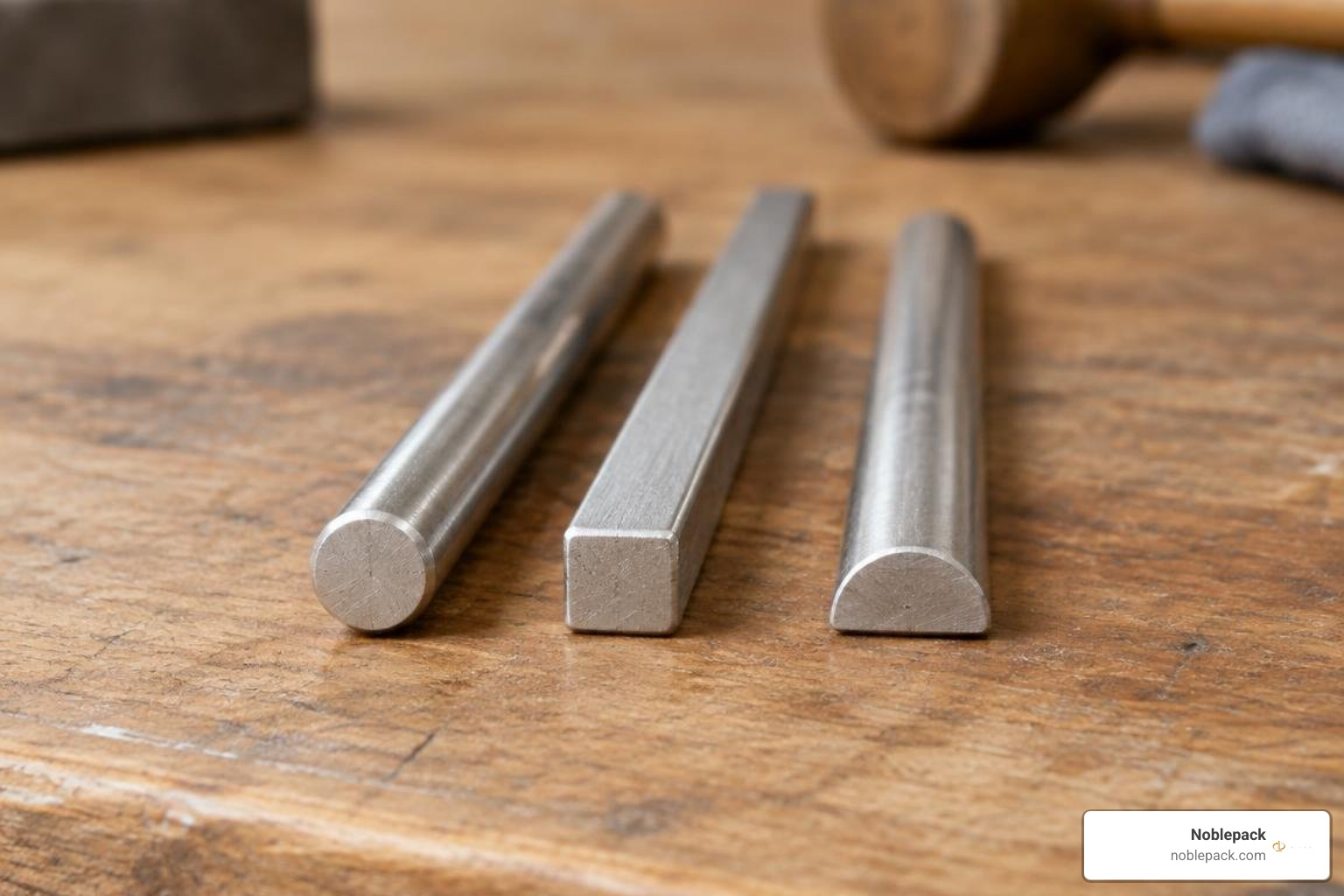
Jewelry wire comes in three primary geometric cross-sections, each serving distinct functional and aesthetic purposes:
- Round Wire: The most versatile profile in jewelry making. Because it has no sharp edges or flat corners, round wire bends uniformly in every direction. It is the industry standard for creating jump rings, ear wires, and simple wire-wrapped loops.
- Square Wire: Featuring a 1.0 mm by 1.0 mm square profile, this wire offers flat, clean exterior surfaces that catch light distinctively. When bundled side-by-side in wire-wrapping projects, square wires sit flush against one another without slipping or twisting over adjacent strands. The flat sides also create a substantially larger contact area for soldering, yielding far stronger joints in fabricated frameworks.
- Half-Round Wire: Featuring one flat face and one domed exterior, half-round wire is the ultimate binding element. When wrapping multiple square base wires together, crafters lay the flat side directly against the core bundle. This creates a secure, low-profile bind that will not mar or slide along the underlying structure.
Choosing Between Dead Soft, Half-Hard, and Full-Hard
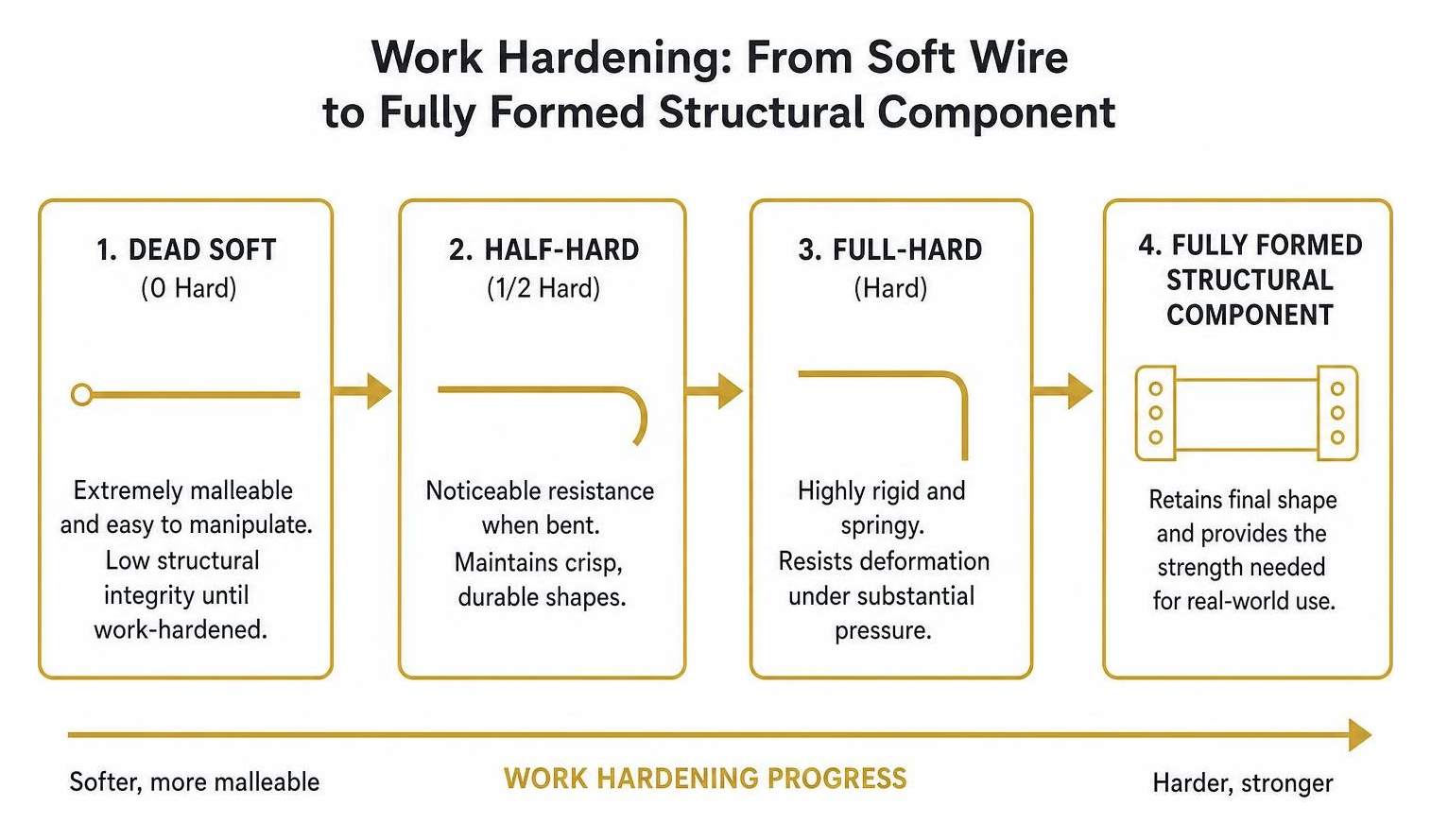
Wire temper describes the metal's internal crystalline hardness, which dictates how easily it bends and how well it retains its final shape under load:
- Dead Soft (0 Hard): Extremely malleable and easy to manipulate using your fingers and basic hand tools. Dead soft wire provides almost zero spring-back, making it ideal for intricate wire wrapping, organic bends, and complex stone cages. However, it offers low structural integrity until work-hardened.
- Half-Hard (1/2 Hard): The sweet spot for structural components. Half-hard wire offers noticeable resistance when bent and maintains crisp, durable shapes. It is the premier choice for handmade ear wires, heavy-duty clasps, structural brooch pins, and load-bearing jump rings. When forming half-hard wire into crisp shapes, a dedicated forming pliers collection ensures uniform bends without surface scarring.
- Full-Hard (Hard): Highly rigid and springy. Full-hard wire resists deformation under substantial pressure, making it ideal for unyielding tiara frames, heavy bangle cores, and tension clasps. Because it is prone to snapping if bent sharply, it requires deliberate, measured manipulation.
Material Comparison and Sourcing Costs
Different metals provide varying levels of durability, workability, and aesthetic appeal. Choosing the right material depends on your project budget, intended wear frequency, and structural demands. When assessing fine metal authenticity, consulting recognized precious metal verification standards ensures that your materials meet proper purity thresholds.
| Material Type | Common Composition | Temper / Characteristics | Typical Cost & Length Range | Best Uses |
|---|---|---|---|---|
| Bare Copper | 99.9% Pure Copper | Dead soft to half-hard; malleable, develops natural antique patina | ~$35.99 for 200 ft (1 lb spool) / ~$10 for 69 ft | Practice wrapping, oxidized vintage jewelry, chainmaille |
| Brass (C26000) | Copper-Zinc Alloy | Annealed/half-hard; rigid, golden luster, excellent solderability | ~$9.99 for 30 ft (square profile) | Structural frameworks, geometric links, clockmaking, metal weaving |
| Craft Aluminum | Anodized Aluminum | Dead soft; ultra-lightweight, easy to manipulate, colorfast | ~$3.19 for 9 ft (3 yards) | Sculptural wire art, oversized lightweight earrings, cosplay accents |
| Enameled Copper | Copper core with polymer coating | Soft to half-hard; tarnish-resistant, vibrant metallic finish | ~$30.79 for 96 ft (32 yards) | Color-stable wrapping, jump rings, fashion jewelry |
| Sterling Silver | 92.5% Silver, 7.5% Copper | Dead soft to full-hard; lustrous, work-hardens well, premium feel | ~$64.30–$65.43 per oz (~$11/ft to $63/5-ft pack) | Fine jewelry, gemstone bezels, artisan ear wires, solid clasps |
| 14/20 Gold-Filled | 14K Gold outer layer (5% by weight) over brass | Half-hard; heirloom quality, thick gold bond, highly durable | ~$21.59 to $28.34 per foot | Luxury artisan jewelry, long-lasting clasps, fine wire settings |
Precious vs. Base Metal Craft Wire
- Sterling Silver (.925): Composed of 92.5% pure silver and 7.5% copper alloy, sterling silver wire balances high-end luster with structural durability. In an 18-gauge round format, dead soft sterling silver weighs approximately 0.08 ounces per foot. It work-hardens exceptionally well under light planishing, creating professional, heirloom-grade jewelry findings.
- 14/20 Gold-Filled: Unlike thin electroplated coatings that wear away, gold-filled wire features a solid outer layer of 14-karat gold mechanically bonded to a brass core, constituting at least 1/20th (5%) of the total product weight. It delivers the beauty and hypoallergenic properties of solid gold at a fraction of the cost, remaining durable through years of daily wear.
- Bare Copper and Brass: Ideal for structural exploration and bold rustic designs. Bare copper readily accepts chemical patinas (such as liver of sulfur) for an antique finish. Cartridge brass (C26000) provides a rigid golden profile with tight manufacturing tolerances (typically within plus or minus 0.02 mm), making it well-suited for crisp solder joints.
- Aluminum and Coated Copper: Aluminum offers maximum flexibility and featherweight wearability, making it comfortable for large, statement-style hoop earrings. Enameled or coated copper wire provides consistent, tarnish-resistant color over a flexible core, ideal for non-soldered fashion accessories.
Bulk Spools vs. Small Lengths: Cost Breakdown
Sourcing wire in bulk delivers substantial savings across all metal types. For example, purchasing 18-gauge bare copper in a 1-pound spool (approx. 200 feet) costs around $35.99—averaging roughly $0.18 per linear foot. Buying smaller 69-foot utility coils shifts the price closer to $0.25 to $0.35 per foot.
In precious metals, unit economics scale similarly. High-grade 14/20 gold-filled round wire often sells for $28.34 for an individual 1-foot cut, but drops to $21.59 per foot when purchased in 25-foot continuous lengths. For sterling silver, buying by the Troy ounce (or multi-ounce bulk packs) reduces the raw unit cost compared to individual pre-cut five-foot retail packages.
Top Jewelry Projects and Working Techniques

At 1.0 mm thick, 18 gauge wire provides sufficient structural strength to support heavier focal stones and maintain tension across working components.
Best Applications for 18 Gauge Jewelry Wire
- Handmade Jump Rings: 18 gauge is the gold standard for connecting heavy pendants, bracelet clasps, and structural links. When wound around a steel mandrel and saw-cut, 18-gauge rings provide exceptional closure security without pulling open under tension.
- Structural Bezels and Pendant Frames: Use 18-gauge dead soft or half-hard wire to construct outer frames for cabochons. The thick wire protects the stone's edges and provides an anchor for finer weaving wires (such as 26 or 28 gauge).
- Artisan Clasps and Bails: Hook-and-eye clasps, toggle bars, and heavy necklace bails benefit from the rigidity of 18-gauge half-hard wire. When shaped accurately, it withstands daily opening and closing cycles without bending out of alignment.
- Chainmaille Weaves: Coiling and cutting 18-gauge wire creates sturdy jump rings with an ideal aspect ratio (inner diameter relative to wire diameter) for classic weaves like Byzantine, European 4-in-1, and Box chain.
- Substantial Ear Wires: While slightly thicker than standard commercial ear wires, 18 gauge works well for bold hook designs, ear climbers, and hoops designed for fully healed piercings.
Safety, Handling, and Work-Hardening Tips
- Flush-Cutting and Deburring: Standard side-cutters leave a sharp, pinched wedge at the end of 1.0 mm wire. Always use high-quality flush cutters with the flat side facing the piece you intend to keep. Smooth cut ends using a cup bur or needle file to eliminate scratches on the skin.
- Protecting Surfaces with Nylon Jaws: Tool marks can mar 18-gauge wire. Use nylon-jaw pliers when straightening bent wire or pulling wraps tight to preserve the clean metal surface.
- Achieving Uniform Loops: To create uniform, repeatable bail loops, ear wire arcs, and jump rings, form wire using multi-size wrap n tap pliers around stepped cylindrical barrels rather than standard tapered round-nose tools.
- Intricate Wire Weaving: For decorative twisting patterns, pairing your hand techniques with wire twisting pliers ensures tight, symmetrical braids across multiple strands.
- Planishing for Strength: After forming dead soft wire into its final shape, lay the piece on a polished steel bench block and tap it lightly with a raw-hide or chasing mallet. This planishing process work-hardens the metal, locking the structural curves permanently in place.
How Wire Thickness Impacts Jewelry Design
Working successfully with jewelry wire requires understanding the inverse gauge scale: as the gauge number increases, the wire diameter decreases.
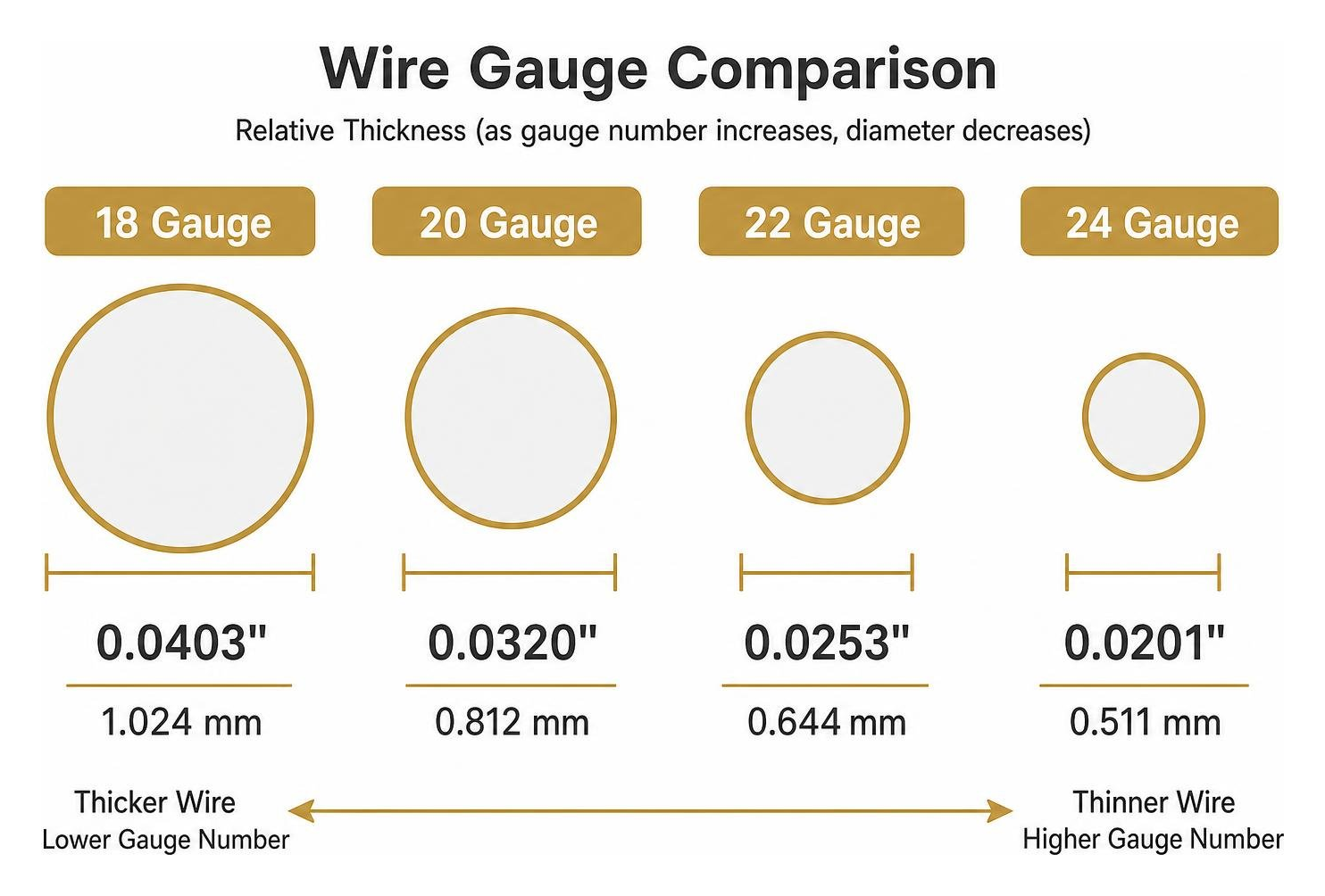
Comparing 18 Gauge Jewelry Wire to 20, 22, and 24 Gauge
| Gauge Size | Diameter (Inches) | Diameter (Millimeters) | Typical Rigidity | Best Suited Jewelry Applications |
|---|---|---|---|---|
| 18 Gauge | 0.0403" | 1.024 mm | Medium-High | Pendant frames, sturdy clasps, chainmaille, heavy jump rings |
| 20 Gauge | 0.0320" | 0.812 mm | Medium | Universal ear wires, headpins, medium-sized gemstone links |
| 22 Gauge | 0.0253" | 0.643 mm | Medium-Low | Briolette wrapping, delicate bead links, lightweight ear wires |
| 24 Gauge | 0.0201" | 0.511 mm | Low | Fine wire weaving, wire coiling, small pearl and bead wrapping |
- 18 Gauge vs. 20 Gauge: While 20 gauge (0.81 mm) is the universal standard for commercial ear wires and delicate wire-loop links, 18 gauge is roughly 25% thicker. That extra mass provides the rigidity needed for load-bearing bracelet clasps and heavy focal frames that 20 gauge cannot support alone.
- 18 Gauge vs. 22 and 24 Gauge: Wires at 22 and 24 gauge excel at passing through fine bead drill holes and weaving intricate patterns around core wires. Attempting to use 18 gauge for small bead wraps will overwhelm delicate stones and crack narrow drill holes.
Bead Compatibility and Structural Limits
Standard freshwater pearls, faceted rondelles, and high-grade gemstones typically feature drill holes between 0.4 mm and 0.8 mm. Because 18 gauge wire is 1.0 mm thick, it will not pass through these smaller drill channels.
For continuous strand bead stringing or threading pearls, replace solid wire with multi-strand flexible stringing wire, and securely fasten the ends with sterling silver tube crimps to ensure smooth drape and dependable strength. Reserve solid 18 gauge wire for large-hole focal beads, lampwork glass, stone donuts, and external architectural frames.
Frequently Asked Questions About Craft Wire Gauges
Can 18 gauge wire fit through standard bead holes?
Most standard semi-precious gemstone beads and pearls have drill holes between 0.5 mm and 0.8 mm, which are too small for 1.0 mm (18 gauge) wire. However, 18 gauge wire readily fits through large-hole ceramic beads, lampwork glass, metal spacer beads, and gemstone donuts.
Is 18 gauge wire suitable for ear wires and clasps?
Yes, but with caveats. Standard commercial piercings typically accommodate 20 gauge to 21 gauge ear wires. While 18 gauge can be used for ear hooks, ensure the wire ends are cleanly rounded with a cup bur or deburring tool. For clasps, hook-and-eye sets, and toggle bars, 18 gauge is one of the most reliable choices available due to its shape retention.
How do you prevent 18 gauge wire from work-hardening too quickly?
Plan your bends before touching the wire with tools. Repetitive bending back and forth in the same spot rapidly work-hardens the metal's internal grain structure, causing it to become brittle and snap. If your bare copper or sterling silver wire becomes stiff while forming, anneal it using a torch to heat the metal to a dull red glow, then quench it to restore its dead soft state (never torch-anneal enameled, plated, or aluminum wire).
Conclusion
Mastering 18 gauge jewelry wire opens up a new tier of structural craftsmanship for DIY jewelry makers. Whether you are assembling chainmaille chains from raw copper, building secure jump rings from half-hard brass, or wrapping stone pendants in sterling silver, 1.0 mm wire provides the strength and stability your projects need.
Once you have shaped, polished, and finished your handmade jewelry, pairing your craftsmanship with high-grade presentation elevates your work. Presenting your finished pieces inside dedicated Noblepack packaging solutions ensures your artisan creations remain protected, professional, and ready to impress.