
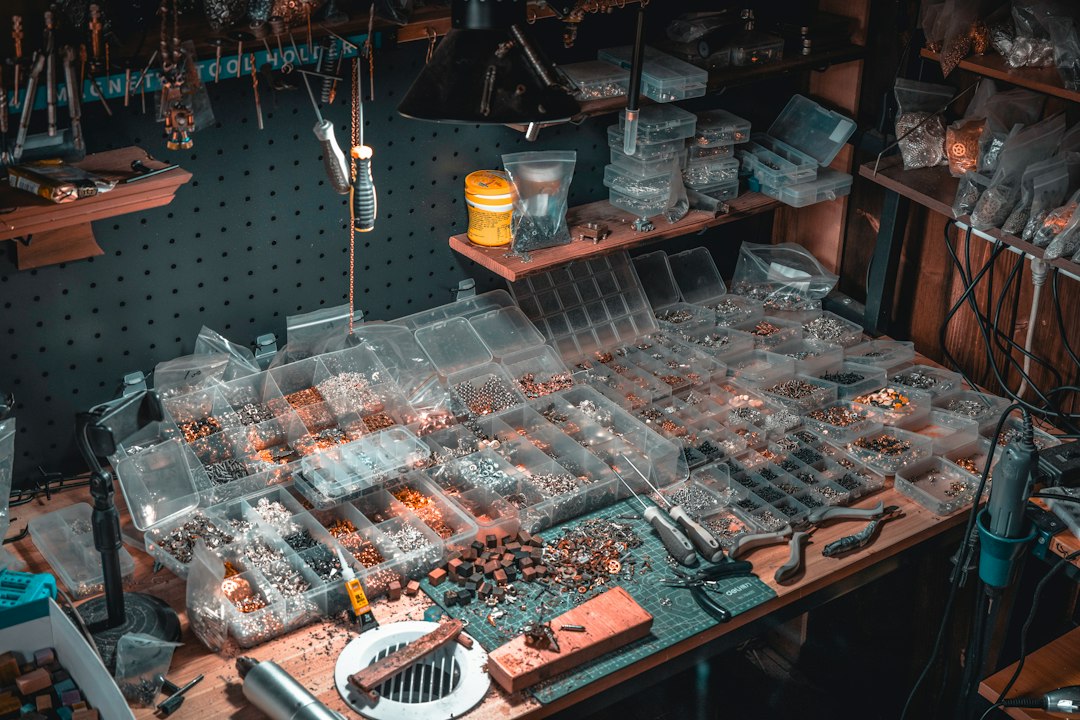
Jewelry Tools: What You Need to Start Making Jewelry
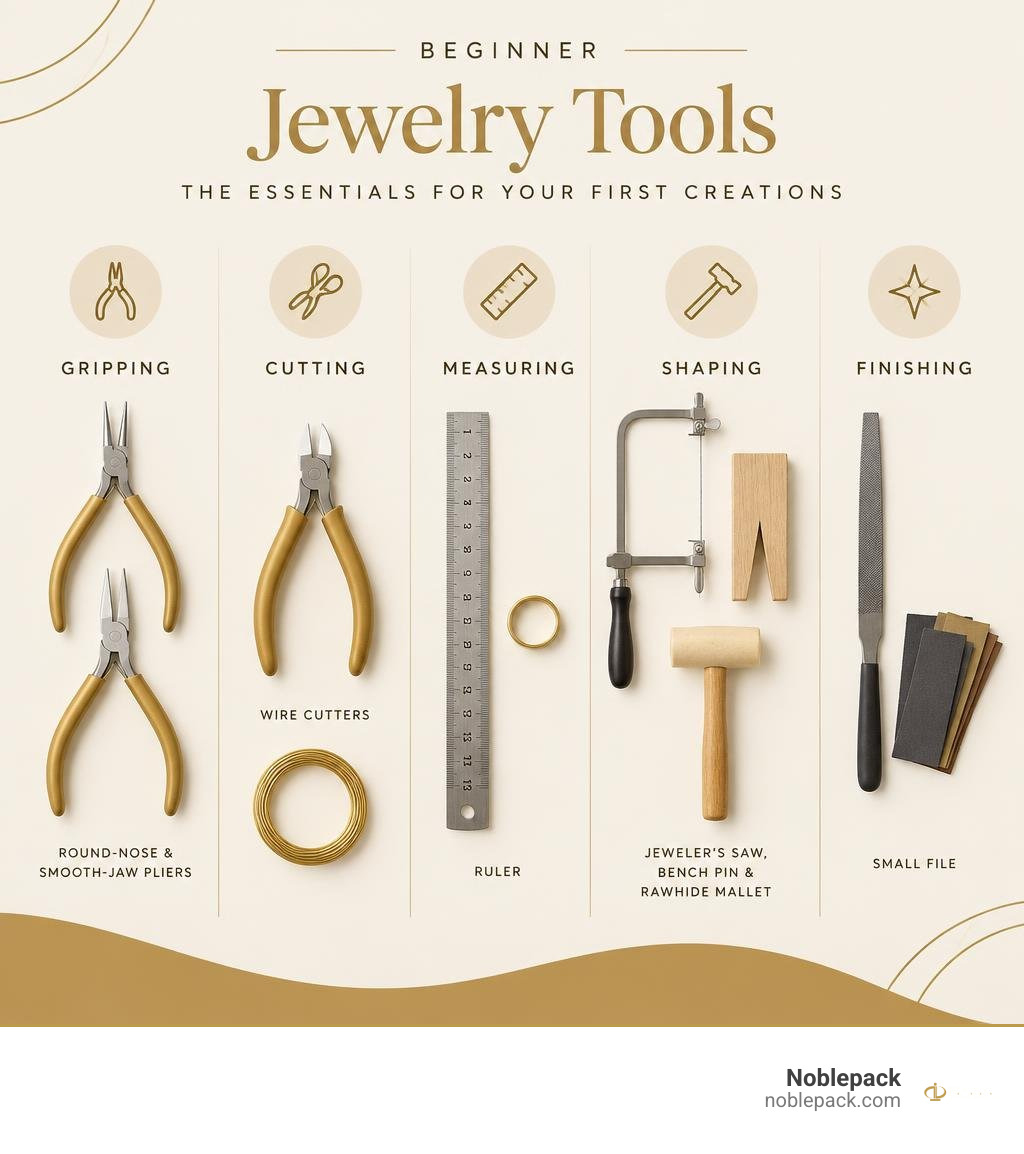
Start with the tools your first project needs. For beading and wirework, get round-nose and smooth-jaw pliers, wire cutters, a ruler, and a small file. If you plan to cut or shape metal, add a bench pin, jeweler's saw, and rawhide mallet. You can leave torches, polishers, and welders until a project calls for them.
The right tools help you make clean joins, accurate cuts, and pieces ready to display or sell. I'm Dannah Davies, and I'll help you build a kit that fits the work you want to do.
Essential Jewelry Tools for Beginners to Start Crafting
When setting up your first metalsmithing bench, choosing the right hand tools makes the difference between an enjoyable afternoon and an exercise in frustration. Metal demands respect, but it also responds beautifully to the right leverage, sharpness, and alignment.
Starting out, you will quickly find that pliers are an extension of your own fingers. Investing in durable precision hand tools ensures your metal never gets marred by rough, serrated machine teeth. To keep soft metals like silver, gold, brass, and copper pristine, always choose smooth-jaw pliers over standard hardware store varieties.
For shaping, refining raw edges, and profiling solder seams, a set of high-cut Grobet Swiss needle files is irreplaceable. Swiss-pattern files feature hardened steel teeth that bite cleanly into non-ferrous stock without skittering across the surface.
Pair your files with a classic German-style jeweler's saw frame (a 3-inch depth is ideal for starters) and an assortment of saw blades ranging from 2/0 for general sawing down to 4/0 for fine piercing. When shaping metal sheet or wire into rings without bruising the surface, a rawhide mallet or non-marring nylon mallet is essential. Unlike steel hammers, rawhide moves metal while protecting your carefully planned surface texture.
| Plier Type | Jaw Profile | Primary Application | Best Paired Wire Gauges |
|---|---|---|---|
| Chain-Nose | Flat interior, tapered exterior | Opening jump rings, gripping in tight spots, bending sharp angles | 18 ga to 26 ga |
| Round-Nose | Smooth, conical round jaws | Creating uniform loops, wire wrapping, curving bends | 16 ga to 24 ga |
| Flat-Nose | Wide, parallel flat jaws | Holding sheet metal, stabilizing wide components, broad right-angle bends | 14 ga to 22 ga |
| Flush Cutters | Angled bypass blades with one flat face | Snipping wire cleanly with minimal burr, trimming prongs | 18 ga to 28 ga (soft metals only) |
Basic Measuring and Layout Equipment
Accurate fabrication begins with millimeter-level precision. In jewelry making, an error of 0.5 mm can alter a ring size completely or cause a gemstone to sit crooked in its setting.
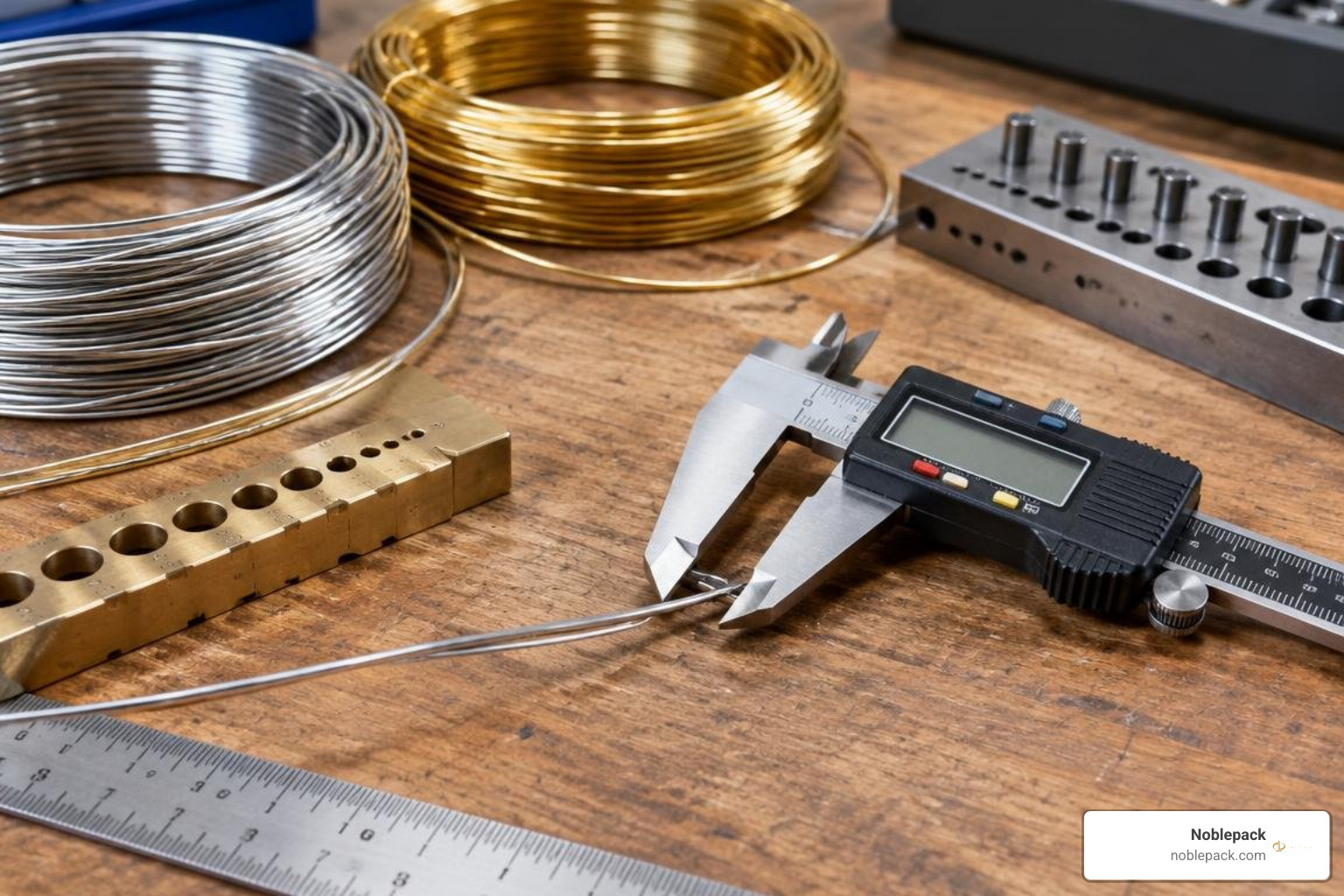
A solid workshop setup relies on dependable measuring instruments:
- Steel Rules & Brass Gauges: Great for rapid sheet stock sizing and checking overall necklace lengths.
- Precision Digital Calipers: Utilizing high-accuracy digital calipers allows you to measure wire diameters, sheet thickness, and stone dimensions down to 0.01 mm.
- Sheet & Wire Metal Gauges: Round slotted steel discs that instantly tell you the American Wire Gauge (AWG) or standard wire gauge of unlabelled stock.
- Steel Dividers: Essential for scribing parallel lines, laying out equal intervals along a ring blank, and plotting geometric stone layouts.
Workspace Setup and Essential Bench Tools
Your jewelry bench needs to be rigid and stable to absorb hammer blows and sawing vibrations. Equipping your station with durable, sturdy bench tools turns any heavy table into a functional jeweler's workspace.
The core of your bench is a hardwood bench pin, typically made of seasoned beech or maple. Mounted securely at chest height, the bench pin supports your metal while sawing, filing, and chamfering. Beside your pin, keep a polished steel bench block or small jeweler's anvil for flattening and work-hardening stock.
When filing or setting components that are too small to grip comfortably by hand, a leather-lined wooden ring clamp distributes clamping pressure evenly without scratching the metal. When forming ring shanks or checking sizes, a graduated steel ring mandrel (triblet) paired with your rawhide mallet allows you to round out metal bands smoothly.
Choosing Specialized Equipment for Soldering, Stone Setting, and Finishing
Joining metal permanently requires controlled heat, appropriate chemistry, and precise positioning tools. A classic starter setup uses a compact butane micro-torch or a multi-gas canister torch capable of heating pieces evenly to silver brazing temperatures (typically between 1,200°F and 1,450°F).
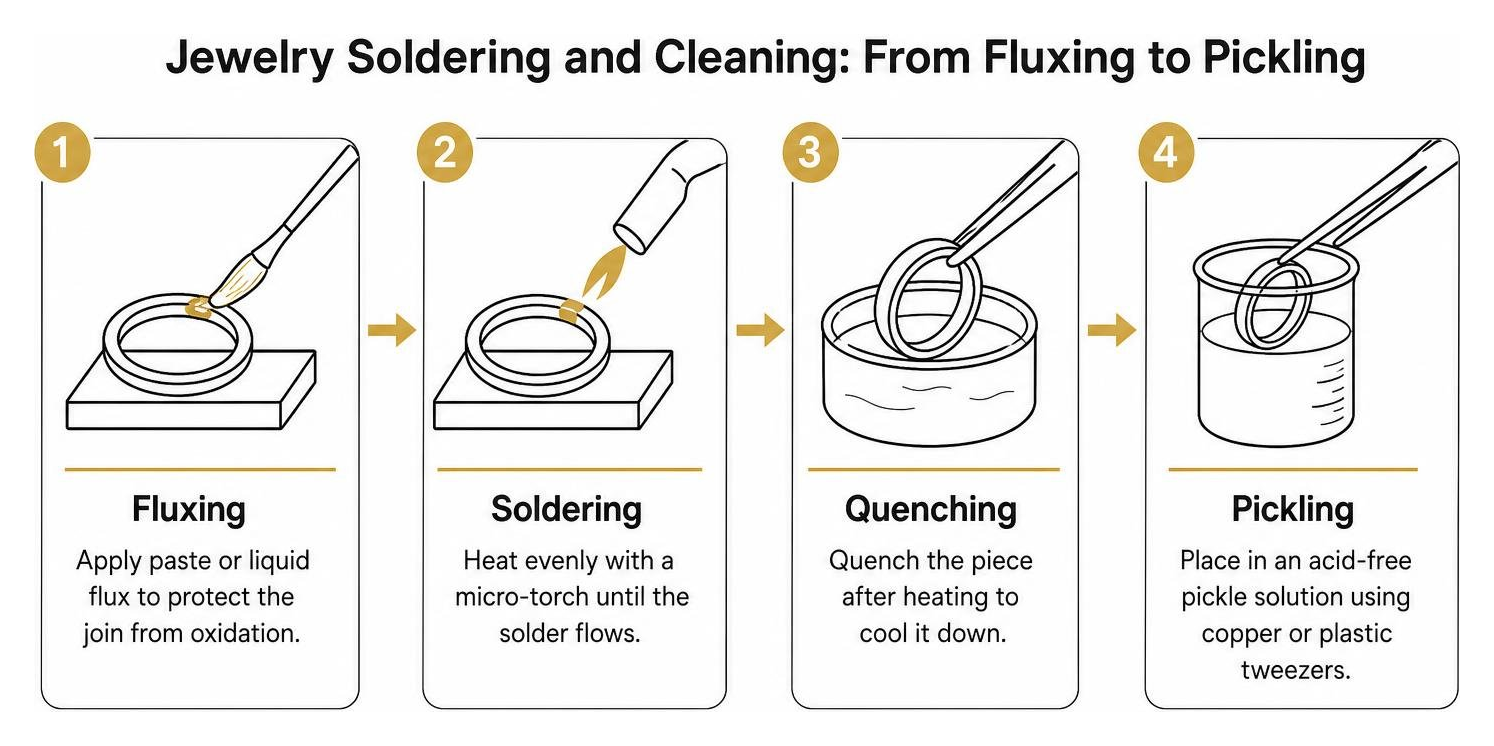
Always perform heat work on a refractory ceramic soldering board, charcoal block, or honeycomb silquar block that reflects heat into the joint. Apply paste or liquid flux to protect the join from oxidation, and use non-locking cross-lock tweezers to hold delicate assemblies. After heating, quench your piece and place it in an acid-free safety pickle solution using copper or plastic tweezers—never steel, which contaminates the bath and causes copper flashing on silver.
When you transition into stone settings, securing gems requires dedicated setting tools. A brass bezel rocker and curved burnisher gently compress metal bezels around cabochons, while hardened steel prong pushers give you positive leverage when closing prongs over faceted stones without slipping into delicate gem facets.
Precision Optical Accessories and Inspection Gear
Metalsmithing relies on fine visual feedback. Spotting microscopic cracks, verifying that solder has fully flowed through a seam, and checking stone pavilion clearance all demand optical magnification.
Hands-free head magnifiers and interchangeable optical accessories with 2.5x to 3.5x lenses let you work naturally at a comfortable focal distance while keeping your posture aligned.
For critical stone inspection, a triplet 10x gemological loupe reveals inclusions, chips, and girdle alignment. When sourcing or confirming precious stones, portable thermal and electrical testers help you verify diamonds, moissanites, and colored stones before fabricating permanent bezels or settings.
Metal Forming and Surface Polishing Equipment
Taking raw casting grain or heavy sheet metal down to custom gauges requires forming equipment that delivers consistent pressure. Jewelers use hand-cranked or motorized rolling mills to reduce sheet thickness, square wire stock, or impress subtle patterns onto annealed metal.
For creating uniform domes and curved beads, a hardened steel dapping punch and block set shapes flat discs into hemispheres. To create clean, circular blanks from non-ferrous sheet metal, the Premium Disc Cutting Kit punches 14 precise disc sizes ranging from 1/8" to 1" (3 mm to 25 mm). Its 7° angled punches and punch-clearing design slice through gold, silver, brass, and copper cleanly, reducing material waste and edge cleanup.
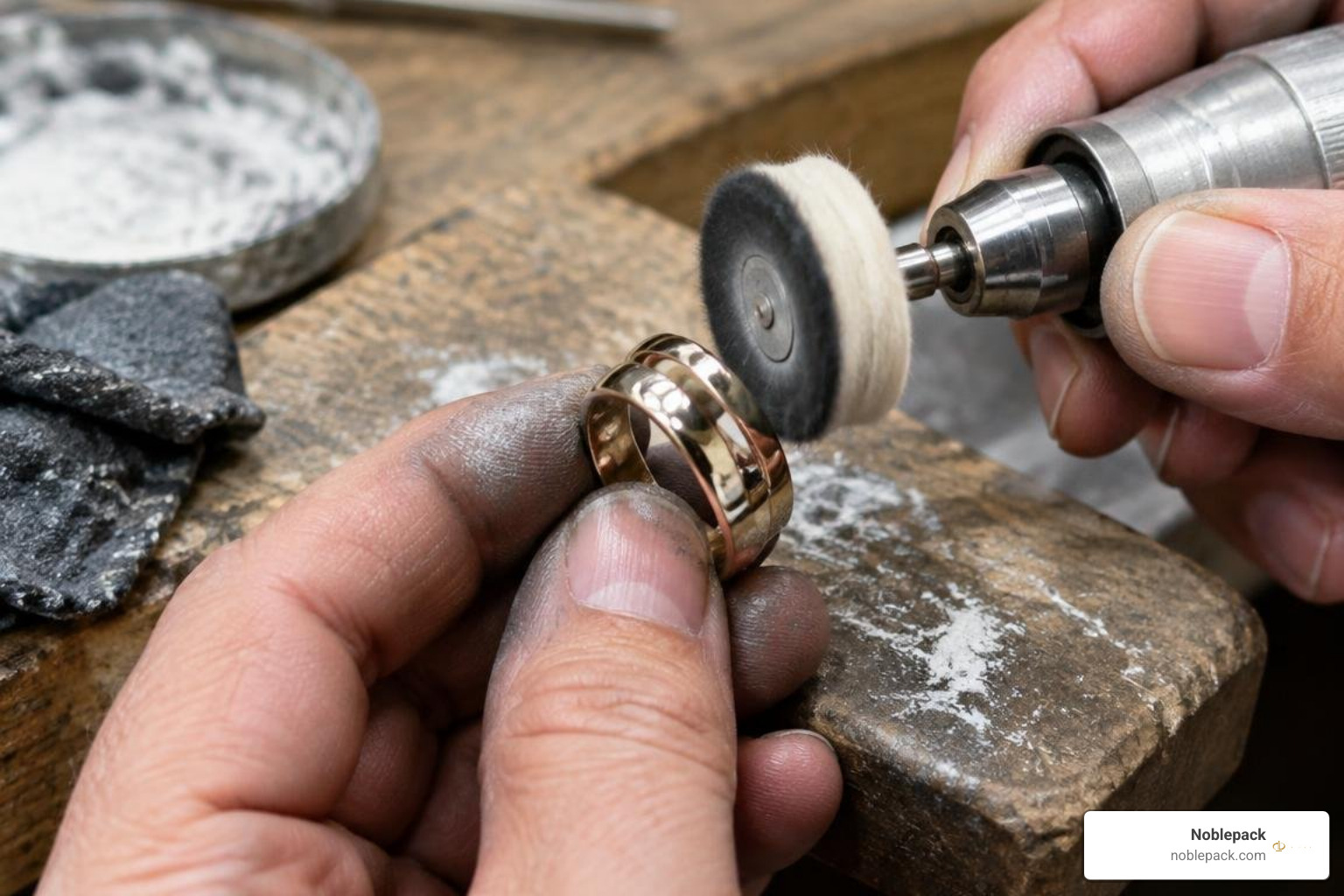
Once fabrication is complete, finishing transforms raw metal into a retail-ready showcase:
- Rotary Flex Shafts & Micromotors: The workhorse for grinding, carving, pre-polishing, and detail sanding using abrasive discs, silicone wheels, and miniature burs.
- Bench Lathes & Dust Collectors: Heavy-duty machines that spin 4-inch to 6-inch cotton, flannel, and muslin buffs at high speeds.
- Polishing Compounds: Applying graded polishing compounds such as Tripoli for scratch removal followed by red rouge or dialux for a mirror finish.
- Specialized Finishing Tools: Modern workshops utilize dedicated polishing equipment, fine-grit sandblasters for contemporary matte finishes, and versatile lapidary equipment like the JOOLTOOL lapidary system for grinding, shaping, and mirror-polishing both stone settings and metallic surfaces.
Advanced Fabrication Systems: Jump Rings, Welding, and Digital Tools
As your jewelry making scales from individual bespoke projects to production collections, repetitive manual tasks can slow down studio throughput. Producing jump rings by hand—coiling wire around a steel rod and hand-sawing each loop—is time-consuming and can yield uneven seam profiles.
Automating this process yields massive material cost savings and superior seam alignment. For medium-volume studios, the Jump Ring Maker Kit includes 20 mandrels (from 2.5 mm to 12 mm) and an ultra-thin 0.008" high-speed steel rotary blade that cuts clean, burr-free jump rings out of gold, silver, and gold-filled coils in seconds.
For large-scale chainmaille or high-volume studio manufacturing, The Ringinator® jump ring maker utilizes a drill-powered continuous feed system capable of flush-cutting over 2,000 aluminum rings in under a minute.
| Material & Specification | Pre-Cut Catalog Cost (per lb) | Raw Wire Cost (per lb) | In-House Production Savings |
|---|---|---|---|
| Bright Aluminum (16 ga, 1/4" ID) | $22.40 | ~$7.00 | $15.40 / lb saved |
| Bright Aluminum (20 ga, 1/8" ID) | $87.84 | ~$7.00 | $80.84 / lb saved |
| Niobium (18 ga, 3/16" ID) | $205.28 | ~$145.00 | $60.28 / lb saved |
| Stainless Steel (20 ga wire) | Hundreds per lb | ~$10.00 | Hundreds / lb saved |
Advanced Bench and Jewelry Tools for Metal Fabrication
Beyond basic hand forming, specialized forming and joining tools expand your studio's capabilities. Hydraulic 20-ton swanstrom-style presses allow you to deep-draw sheet metal into seamless vessels, stamp dramatic relief textures, and cut shapes using pancake dies without fatiguing your hands.
For surface detailing, high-speed pneumatic power systems support intricate hand engraving on rings and lockets. When securing delicate pearls, cabochons, or mixed-media inlays where torch heat is not an option, specialized, non-yellowing industrial adhesives create permanent bonds without damaging organic materials.
Innovative Permanent Jewelry Tools and Pulse Arc Welders
Micro-welding technology has transformed custom jewelry, repairs, and the rapidly growing permanent jewelry industry. Micro pulse arc welders deliver a targeted electrical pulse that ionizes a small shielding envelope of argon gas, creating a localized plasma discharge that fuses metals cleanly in milliseconds.
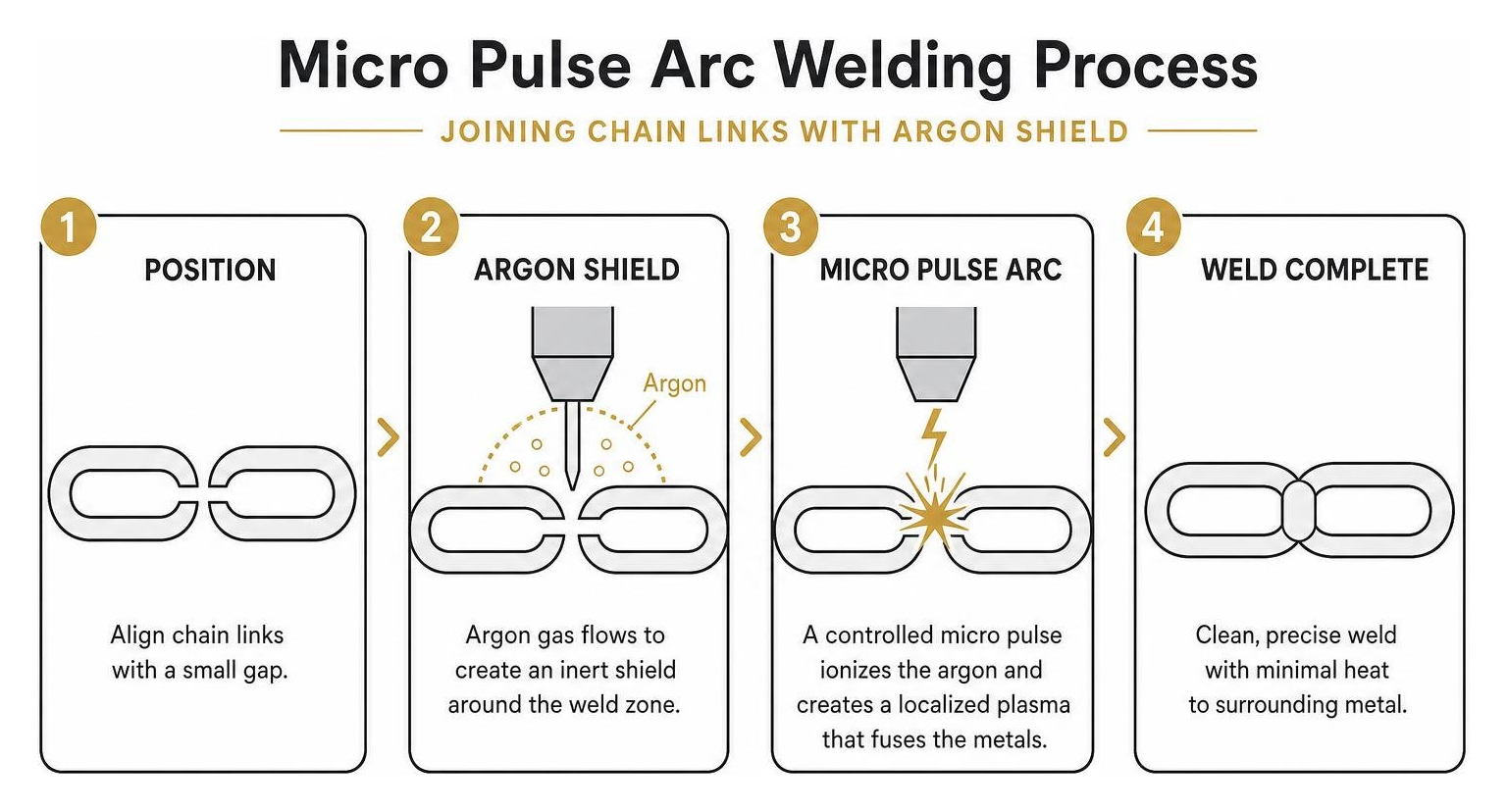
Unlike a soldering torch, pulse arc welding introduces minimal heat into the surrounding piece, allowing jewelers to weld links right next to heat-sensitive gemstones or directly on a client's wrist.
Key options in modern micro-welding include:
- Helix Permanent Jewelry Welder™: A compact unit with a 1 to 30 joule power range, on-demand argon management, a digital interface, and a 1,000,000-weld / 3-year warranty for solid gold, gold-filled, sterling silver, and stainless steel chains.
- Orion mPulse Pulse Arc Welder: Offers 27 power increments across a 3 to 30 joule range with spot sizes from ~1.0 mm to 1.5 mm, making it ideal for chain links, prong re-tipping, and porosity filling.
- Dedicated Studio Welders & Laser Systems: Advanced tabletop laser welders enable seamless seam fills on platinum and titanium.
- 3D Resin Printers: For rapid prototyping, high-resolution direct-castable photopolymer resin printers allow designers to test complex ring fits and create lost-wax casting trees directly from digital CAD files.
Maintenance, Care, and Longevity of Your Studio Equipment
High-grade jewelry equipment can last for generations when properly maintained. Moisture, acidic flux fumes, and metal swarf are the primary enemies of precision bench equipment.
To protect your studio investment:
- Prevent Rust on Steel: Wipe down bench blocks, calipers, pliers, and dapping sets regularly with a light coat of mineral oil, jojoba oil, or specialized corrosion-inhibiting lubricants.
- Preserve Cutting Blades: Always use cutting lubricant (like PepeLube or beeswax) when running jeweler's saw blades, disc punches, and rotary burs. Lubrication reduces friction, prevents teeth from galling, and keeps blades sharper longer.
- Clean Needle Files: Never clean hardened steel files with wire brushes that can dull the teeth. Instead, use a natural brass file card, brushing parallel to the cut grooves to clear trapped silver and gold filings.
- Ultrasonic & Chemical Hygiene: Keep ultrasonic cleaning units filled with fresh, non-ammoniated solutions, and wipe down chemical pickling areas thoroughly to prevent airborne acid residues from corroding nearby steel hand tools.
Frequently Asked Questions About Jewelry Tools
What are the first tools a beginner should buy for jewelry making?
A beginner should start with a reliable four-piece plier set (chain-nose, round-nose, flat-nose, and flush cutters), a 3-inch German saw frame with an assortment of 2/0 to 4/0 blades, a set of Swiss-cut needle files, a hardwood bench pin with clamp, a steel ruler, and a rawhide mallet. This foundational toolkit enables you to cut, shape, file, and construct a wide variety of wire and sheet metal jewelry without a large initial investment.
What is the difference between hobbyist and professional grade equipment?
The difference lies in metal hardness, machining tolerances, alignment, and ergonomics. Hobbyist tools often use softer carbon steel that can warp, pit, or lose jaw alignment under steady pressure. Professional tools feature hardened, tool-grade alloy steel, smooth box joints that eliminate side-play, ground flat faces that prevent marring, and balanced handles designed to reduce hand fatigue during long production sessions.
How does pulse arc welding work for permanent jewelry?
Pulse arc welding uses a brief electrical burst (typically between 1 and 30 joules) channeled through a sharpened tungsten electrode. When the electrode touches the grounded metal chain link and retracts, it strikes an electrical arc that forms a localized plasma field. This melts the two wire ends together in a fraction of a second. An inert argon gas shield prevents atmospheric oxidation, resulting in a clean, smooth, clasp-free weld without heating the rest of the chain.
Conclusion
Building your jewelry workshop is a step-by-step process. By starting with essential hand tools and gradually adding specialized forming, soldering, and welding equipment as your projects demand, you develop a natural feel for how precious metals behave at the bench. Quality tools make fabrication more consistent, minimize metal waste, and help bring your creative designs to life.
Once your pieces are polished, set, and inspected, presenting them well completes the customer experience. Explore Noblepack custom jewelry packaging solutions for quality presentation boxes, pouches, displays, and shipping mailers that give your handmade designs the refined, professional presentation they deserve.