
Core Types of Gold Purity Checking Machine Technologies
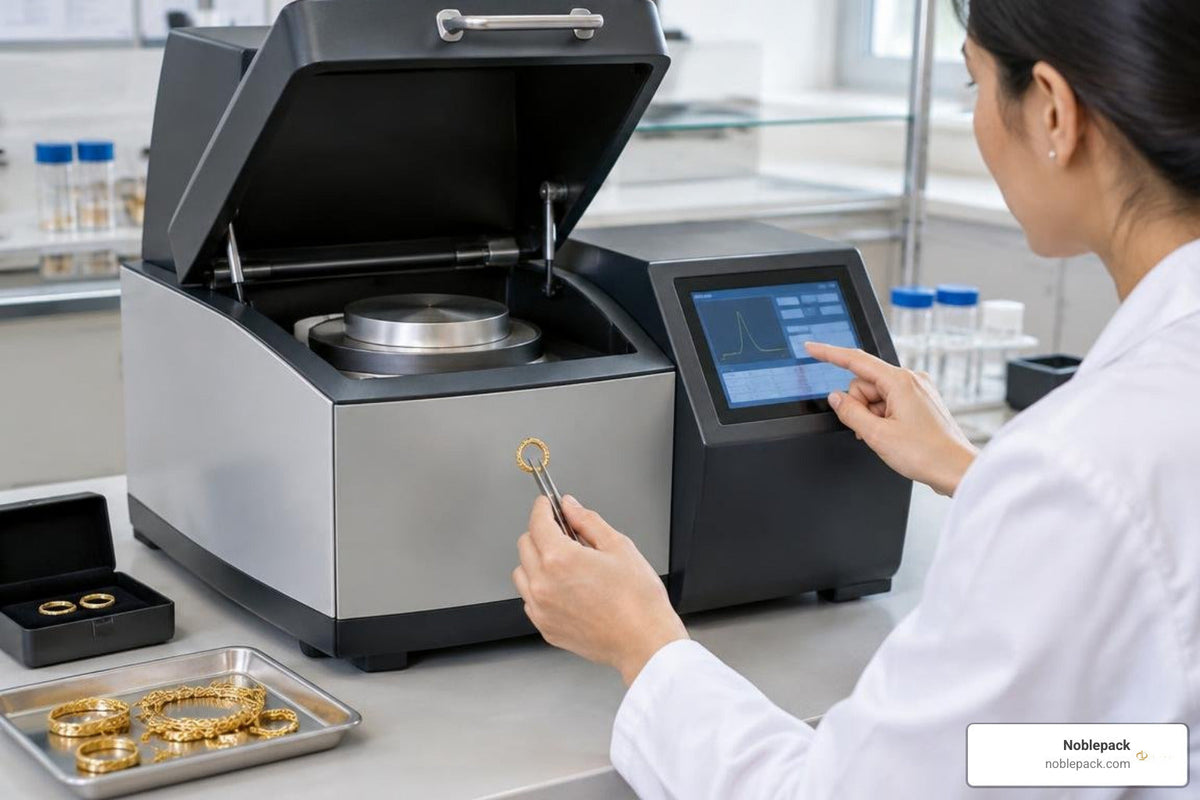
For jewelers, the best gold purity checking machines are non-destructive XRF spectrometers for multi-element surface analysis and hydrostatic electronic density meters for bulk purity verification. XRF spectrometers identify exact alloy composition and plating, while density meters confirm solid pieces by measuring specific gravity. Choosing the right testing method starts with understanding how each instrument analyzes precious metals. Modern jewelry testing balances precision against the physical preservation of valuable pieces. Historically, traditional fire assay was considered the ultimate benchmark, but it requires melting, scraping, or chemically degrading samples—a process completely impractical for finished retail rings, intricate estate heirlooms, or hallmarked inventory.
Today, non-destructive testing dominates the market. Purity testing accounts for roughly 60% of the entire precious metal test segment, with rapid, non-destructive methods providing immediate verification while keeping items intact. For a deeper look at industry testing procedures, review our comprehensive gold testing complete guide for 2026. Let's examine the three core non-destructive technologies available today.
X-Ray Fluorescence (XRF) Spectrometers
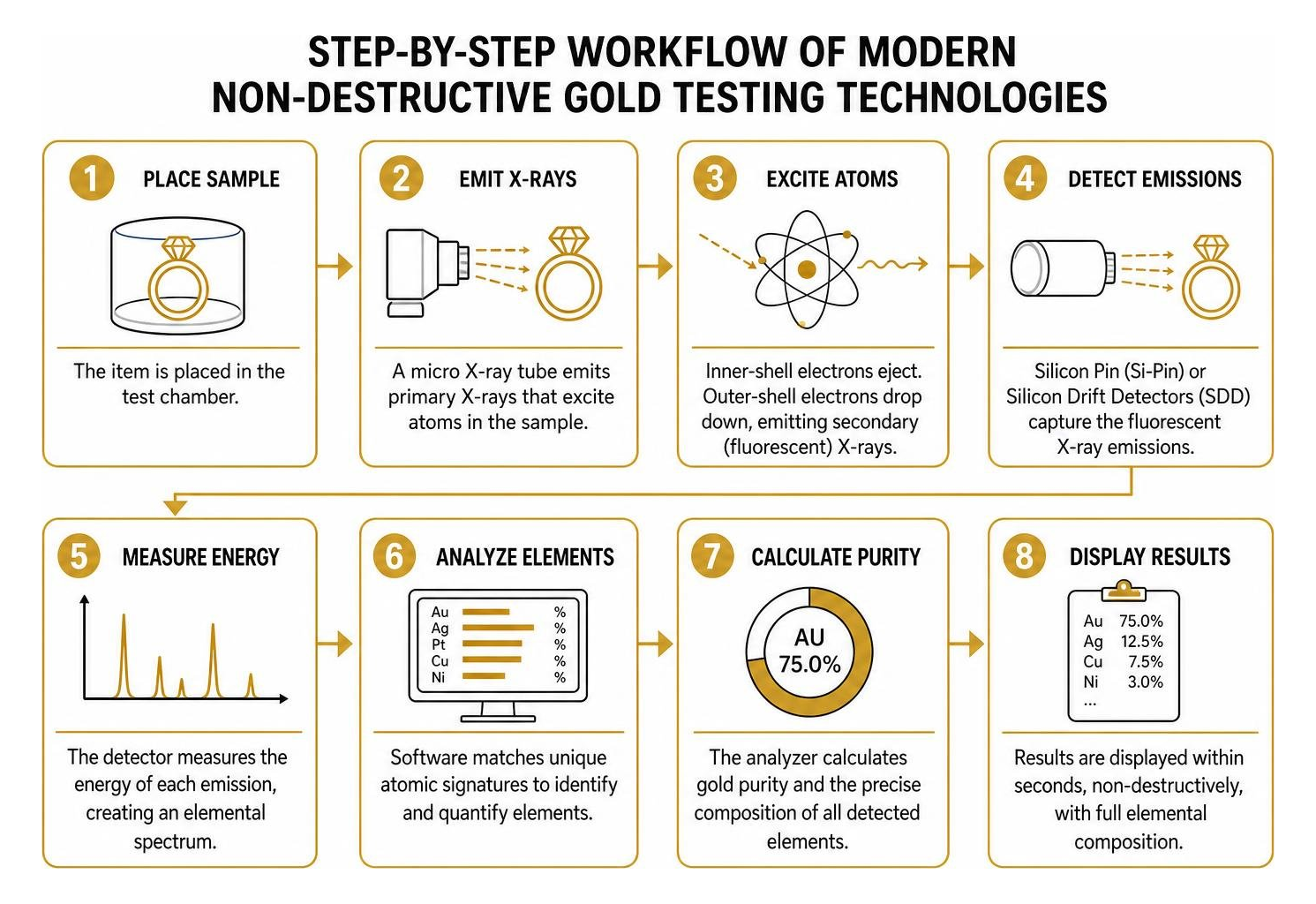
X-Ray Fluorescence (XRF) spectrometers are the gold standard for non-destructive elemental analysis. When an item is placed in the test chamber, a micro X-ray tube emits primary X-rays that excite the atoms in the sample. This causes inner-shell electrons to eject, and as outer-shell electrons drop down to fill the vacancies, they release secondary (fluorescent) X-rays.
Silicon Pin (Si-Pin) or Silicon Drift Detectors (SDD) capture these fluorescent energy emissions. Because each element has a unique atomic signature, the analyzer's software calculates the precise elemental composition across dozens of elements simultaneously—from gold (Au), silver (Ag), and platinum (Pt) to dangerous or alloying elements like nickel (Ni), cadmium (Cd), and copper (Cu). Advanced systems like the Aurora 900 Precious Metal Analyzer and industrial units described in scientific research on high-precision precious metal analysis deliver full compositional readouts down to parts-per-million (ppm) within seconds.
Hydrostatic Electronic Density Meters
Digital density meters operate on Archimedes' principle of buoyancy. The device measures the sample's weight in air and its apparent weight submerged in a water tank. Using the formula:
$$\text{Density} = \frac{\text{Weight in Air}}{\text{Weight in Air} - \text{Weight in Water}} \times \text{Water Density}$$
The internal processor cross-references this specific gravity against known density tables for gold alloys to compute exact karat values and purity percentages. For solid jewelry, bullion, and scrap gold, instruments like the GKS-3000 provide reliable, chemical-free testing. Detailed technical assessments and evaluation of non-destructive density testing show that modern density meters achieve high repeatability when working with solid, non-porous items.
Portable Electronic Conductivity Pens and Acid Kits
Electronic gold testing pens evaluate the electrical conductivity and electrochemical resistance of a metal's surface when touched with an electrolytic gel probe. While compact and affordable, they only measure the outermost atomic layers and cannot detect thick plating or core substitutions.
Traditional acid testing requires rubbing the item across a novaculite touchstone and applying nitric acid solutions of varying strengths (10K, 14K, 18K, 22K). While cost-effective for coarse screening, acid testing causes micro-abrasions to jewelry, poses safety hazards from chemical handling, and relies heavily on subjective visual color interpretation.
XRF Analyzers vs. Digital Density Meters: Key Differences and Limitations
When investing in professional testing equipment, jewelers and pawnbrokers primarily choose between XRF spectrometers and digital hydrostatic density meters. Each technology comes with distinct strengths and operational limitations.
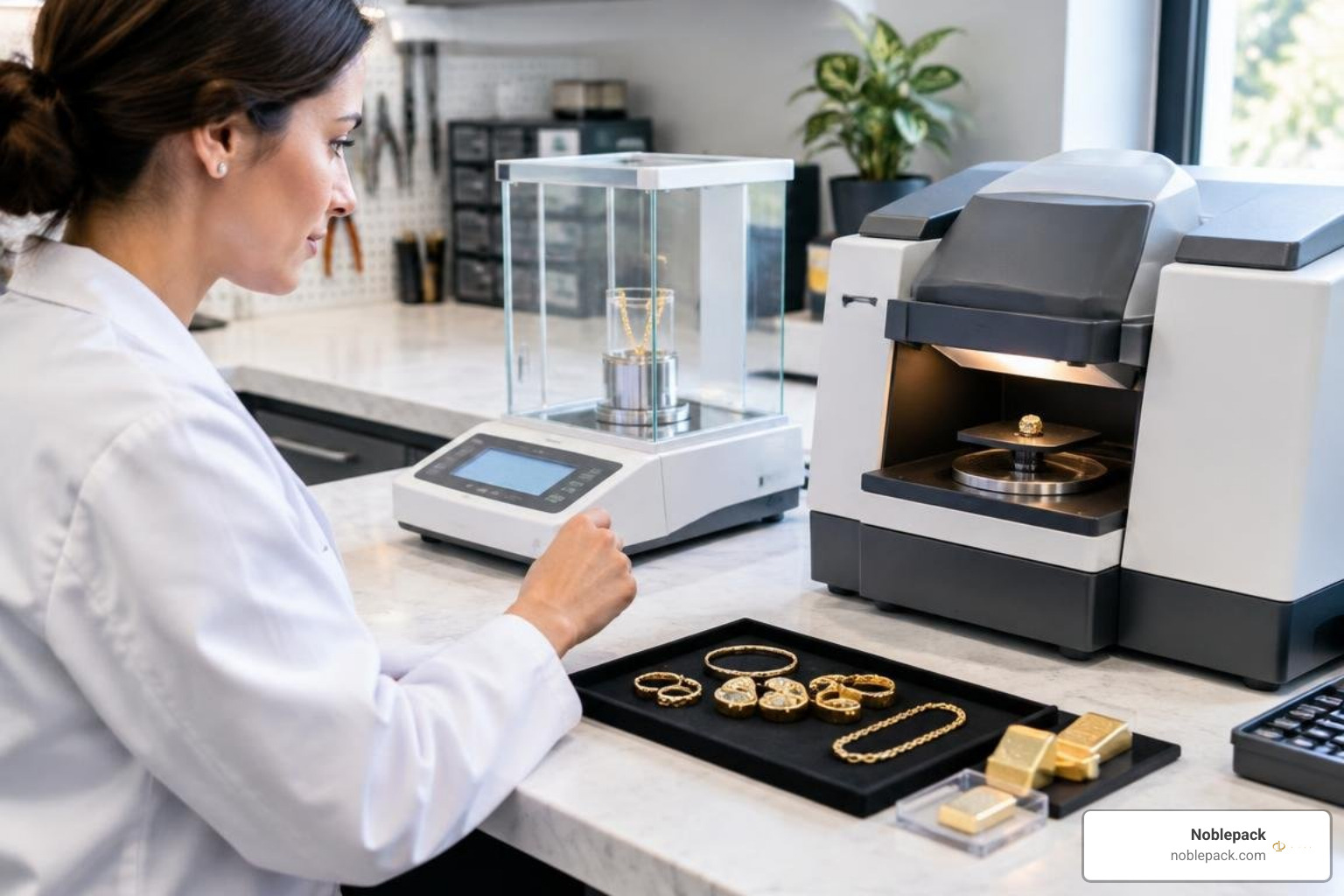
XRF analyzers excel at multi-element breakdown, allowing jewelers to detect dangerous trace elements like lead or cadmium, identify gold plating, and measure exact alloying ratios in white, rose, and yellow gold. However, XRF is fundamentally a surface and near-surface measurement technology; X-rays penetrate only 10 to 50 micrometers into metal. If a counterfeit piece features an unusually thick gold cladding over a tungsten or brass core, a standalone surface scan might miss the underlying base metal unless paired with small-spot targeting or deeper verification tools.
Conversely, digital density meters measure the mass and volume of the entire item, evaluating the total bulk density rather than just the surface. This makes them effective for verifying solid bars and uniform cast pieces. However, density meters cannot evaluate hollow items, jewelry set with gemstones, or pieces containing internal air pockets, as trapped air drastically lowers the calculated specific gravity, leading to false under-karat readings.
| Feature / Criteria | XRF Spectrometers | Digital Hydrostatic Density Meters |
|---|---|---|
| Measurement Principle | Characteristic secondary X-ray emissions | Archimedes' buoyancy & specific gravity |
| Detection Depth | Surface to near-surface (10–50 µm) | Entire bulk object volume |
| Elemental Breakdown | Multi-element (up to 30–74 elements) | Total density only (no elemental split) |
| Hollow Jewelry Testing | Yes (measures surface metal composition) | No (trapped air distorts density calculations) |
| Gemstone-Set Jewelry | Yes (targeted small-spot collimator) | No (gemstones skew overall density) |
| Average Test Speed | 5 to 60 seconds | 20 to 60 seconds |
| Price Range (USD) | $4,000 – $25,000+ | $300 – $3,500 |
Top Testing Equipment Reviewed: Specifications, Pricing, and Performance
Selecting the best gold testing machinery requires evaluating throughput needs, analytical precision, weight capacities, and compliance standards. With the gold testing machine market demonstrating steady long-term growth, modern benchtop analyzers deliver lab-grade assay accuracy directly to the retail floor. If you deal heavily in cast bars and minted coins, explore our dedicated gold bullion tester solutions for specialized high-volume configurations.
Top-Rated Gold Purity Checking Machine Models for Jewelers
Several commercial models stand out across professional retail, pawnbroking, and laboratory environments:
- Aurum5 Pro XRF Analyzer: Equipped with a high-resolution Si-Pin diode detector and FP2.0 analytical algorithms, the Aurum5 Pro All-Metal Gold Testing Machine delivers testing accuracy of $\pm0.15\%$ (and down to $0.03\%$ on high-purity gold). It detects over 30 elements simultaneously and features built-in compliance software without requiring an external PC.
- AccuGold iEDX-100AC: Developed for high-volume banking and jewelry analysis, the AccuGold iEDX 100AC Machine analyzes elements from Titanium (atomic number 22) to Uranium (atomic number 92), testing up to 10 elements simultaneously while compensating for surface coatings.
- EDS5800PLUS XRF Metal Analyzer: Designed for speed and high-throughput buying counters, the EDS5800PLUS XRF Metal Analyzer achieves $\pm0.05\%$ accuracy on gold samples above 96% purity, delivering full karat and elemental reports in 5 to 60 seconds.
- DE-120K Densitometer: Featuring a digital balance resolution and a composition range from 1 ppm to 100%, the DE-120K Electronic Gold Purity Densitometer provides an RSD repeatability $\le 0.05\%$ for high-karat gold and connects directly to thermal receipt printers.
- GKS-3000 Density Tester: A heavy-duty workhorse density balance, the GKS-3000 Purity Density Tester handles sample weights from 0.01 g up to 3,000 g (3 kg), making it suitable for large bullion ingots, scrap melting lots, and solid platinum wares.
- Generic Amazon Densitometers: For budget-focused shops, entry-level digital scales like the Generic Gold Tester Machine on Amazon offer basic Archimedean gravity measurements for scrap testing under $1,100.
- SPW Portable XRF: Industrial units like the SPW High-Precision Portable XRF Analyzer and retail evaluation solutions featured by Old Bridge Gold Evaluations offer handheld and compact benchtop analysis for traveling buyers and scrap evaluators.
| Equipment Model | Technology Type | Weight / Meas. Range | Accuracy / Precision | Typical Test Duration |
|---|---|---|---|---|
| Aurum5 Pro | Benchtop ED-XRF | Solid / Liquid / Powder | $\pm0.15\%$ (down to $0.03\%$) | 10 – 30 seconds |
| AccuGold iEDX-100AC | Benchtop XRF | Ti (22) to U (92) Range | High Resolution Si-Pin | 15 – 45 seconds |
| EDS5800PLUS | Benchtop XRF | 0.01% – 99.99% Au | $\pm0.05\%$ (Au $\ge 96\%$) | 5 – 60 seconds |
| DE-120K | Electronic Density Meter | 0.001 g – 120 g | RSD $\le 0.05\%$ (Au $\ge 90\%$) | 10 – 120 seconds |
| GKS-3000 | Electronic Density Meter | 0.01 g – 3,000 g | 0.01 g/cm³ density res. | 20 – 40 seconds |
How to Choose a Gold Purity Checking Machine by Business Profile
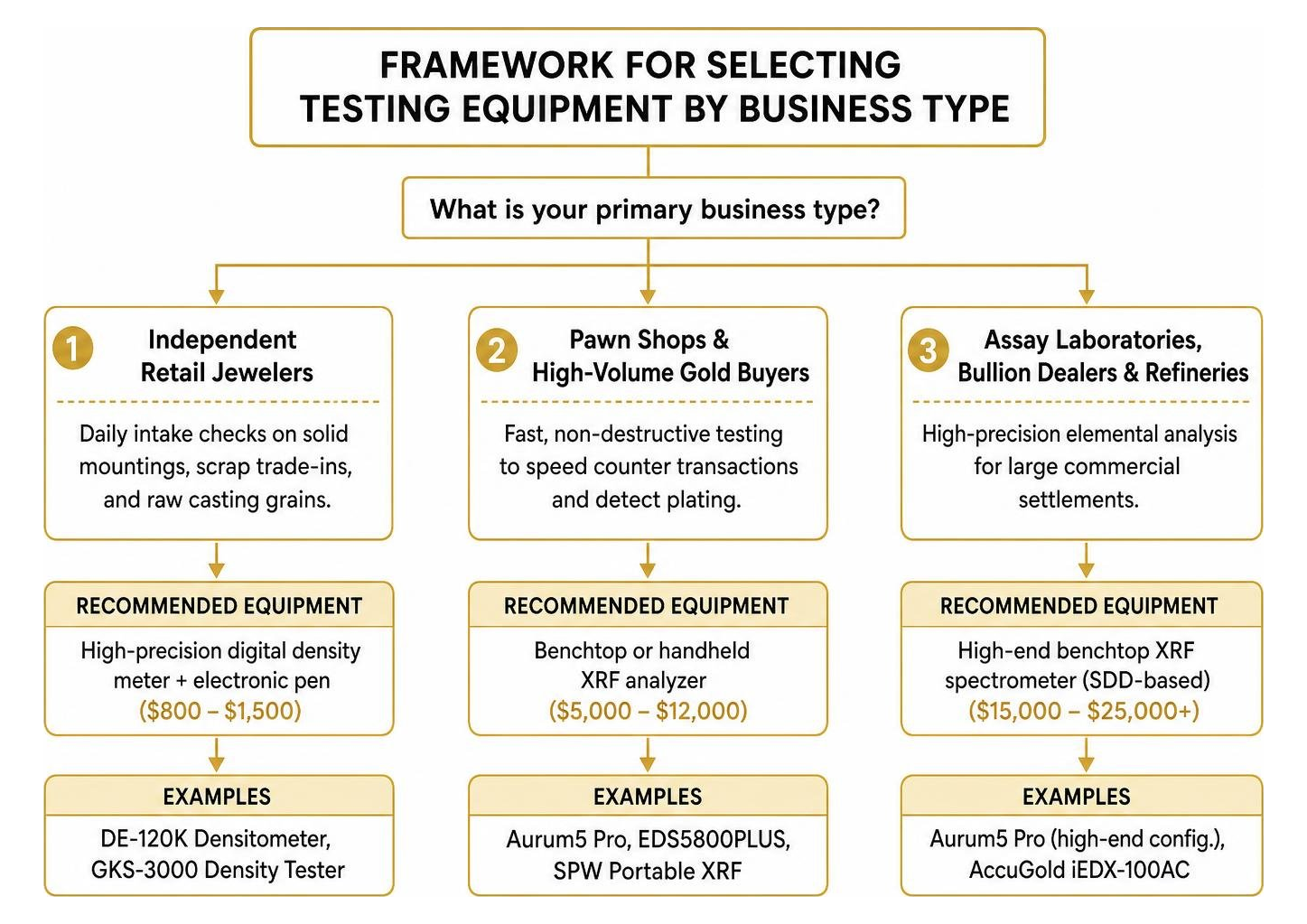
- Independent Retail Jewelers: A high-precision digital density meter ($800–$1,500) paired with an electronic pen covers daily intake checks on solid mountings, scrap trade-ins, and raw casting grains.
- Pawn Shops and High-Volume Gold Buyers: A benchtop or handheld XRF analyzer ($5,000–$12,000) is recommended. The ability to scan items in 10 seconds without acid damage speeds up counter transactions and detects plating before issuing loans.
- Assay Laboratories, Bullion Dealers, and Refineries: High-end SDD-based benchtop XRF spectrometers ($15,000–$25,000+) capable of detecting 30+ elements to four decimal places provide the precision needed for large commercial settlements.
Essential Industry Standards and Safety Certifications
Because XRF spectrometers utilize ionizing radiation to excite atomic structures, safety and regulatory compliance are essential:
- Radiation Safety (AERB / FDA / CE): Professional benchtop XRF units must feature interlocked, fully shielded radiation chambers with automatic beam shutoff when opened. Look for CE, RoHS, IP54, and AERB (Atomic Energy Regulatory Board) certifications where applicable.
- Electromagnetic Compatibility (FCC / CE): Ensures that high-voltage X-ray tubes and digital microprocessors do not interfere with retail point-of-sale systems or wireless store networks.
- Hallmarking & Traceability Standards: In regions with strict purity governance, select machines equipped with integrated hallmarking compliance functions (such as BIS HUID compliance modules) and integrated report-generation tools to maintain verifiable digital audit trails.
Frequently Asked Questions About Gold Purity Testing
How accurate are handheld electronic gold testing pens?
Handheld electronic pens are designed primarily for quick, preliminary screening rather than definitive assaying. Because they measure surface conductivity through a localized gel drop, they can struggle to distinguish between solid karat gold and high-grade heavy gold electroplating. They provide approximate karat brackets (e.g., distinguishing 10K from 14K or 18K), but they should be supplemented with density or XRF testing for high-value transactions.
Can density-based gold testers accurately evaluate hollow jewelry?
No. Hydrostatic density meters calculate purity by measuring the total volume of water displaced by the item. If a piece of jewelry is hollow (such as a hollow rope chain or stamped bangle), air trapped inside the inner cavity increases overall volume without adding corresponding mass. This artificially lowers the calculated specific gravity, causing the machine to read the item as significantly lower karat or fake.
What is the expected price range across entry-level to high-end gold testers?
Gold testing equipment spans three main pricing tiers:
- Entry-Level ($30 to $300): Basic chemical touchstone acid kits and portable electronic conductivity pens for hobbyists and rough spot-checks.
- Mid-Range ($800 to $2,500): High-precision hydrostatic electronic density balances with digital readouts, automated water tanks, and thermal receipt printers.
- Professional & Enterprise ($4,000 to $25,000+): High-performance benchtop and handheld XRF spectrometers with Si-Pin or SDD detectors for comprehensive multi-element analysis.
Conclusion
Accurate purity verification protects your margins, builds customer confidence, and ensures regulatory compliance. Once a piece has been verified for authenticity, presenting it in refined packaging completes the customer experience. Explore our curated selection of professional gold purity testing machines and pair your certified inventory with our signature presentation packaging collections to elevate every transaction.