
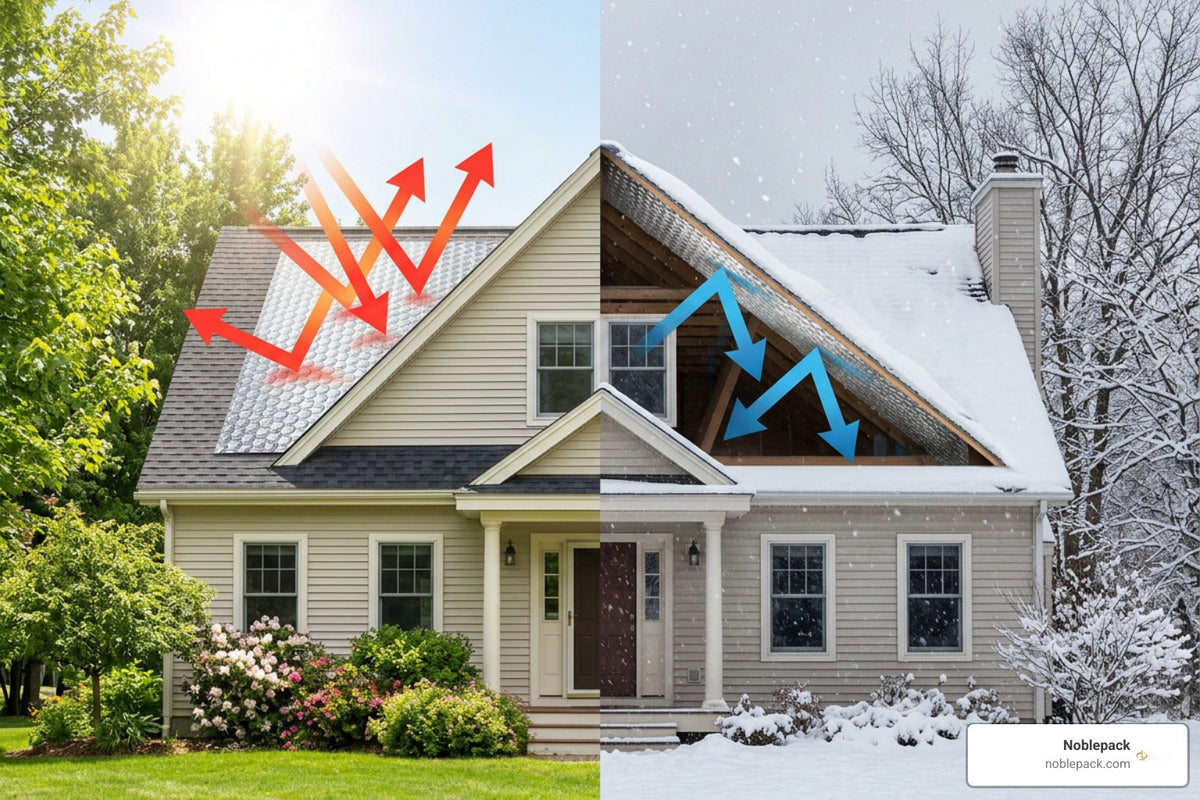
How Bubble Foil Wrap Regulates Temperatures in Summer and Winter
Bubble foil wrap regulates temperature by reflecting up to 94% to 96% of radiant heat away from a space in summer and helping retain indoor warmth in winter. Its reflective foil surface redirects radiant energy, while the trapped air bubbles create a thermal break that slows heat transfer and helps reduce condensation across seasonal temperature swings.
Maintaining a stable indoor climate or protecting precious cargo throughout changing seasons can be challenging. Whether you are dealing with blistering summer sun or freezing winter winds, controlling heat transfer is essential.
Standard materials often fight an uphill battle against ambient conditions, but radiant barrier systems tackle the physics of thermal energy directly.
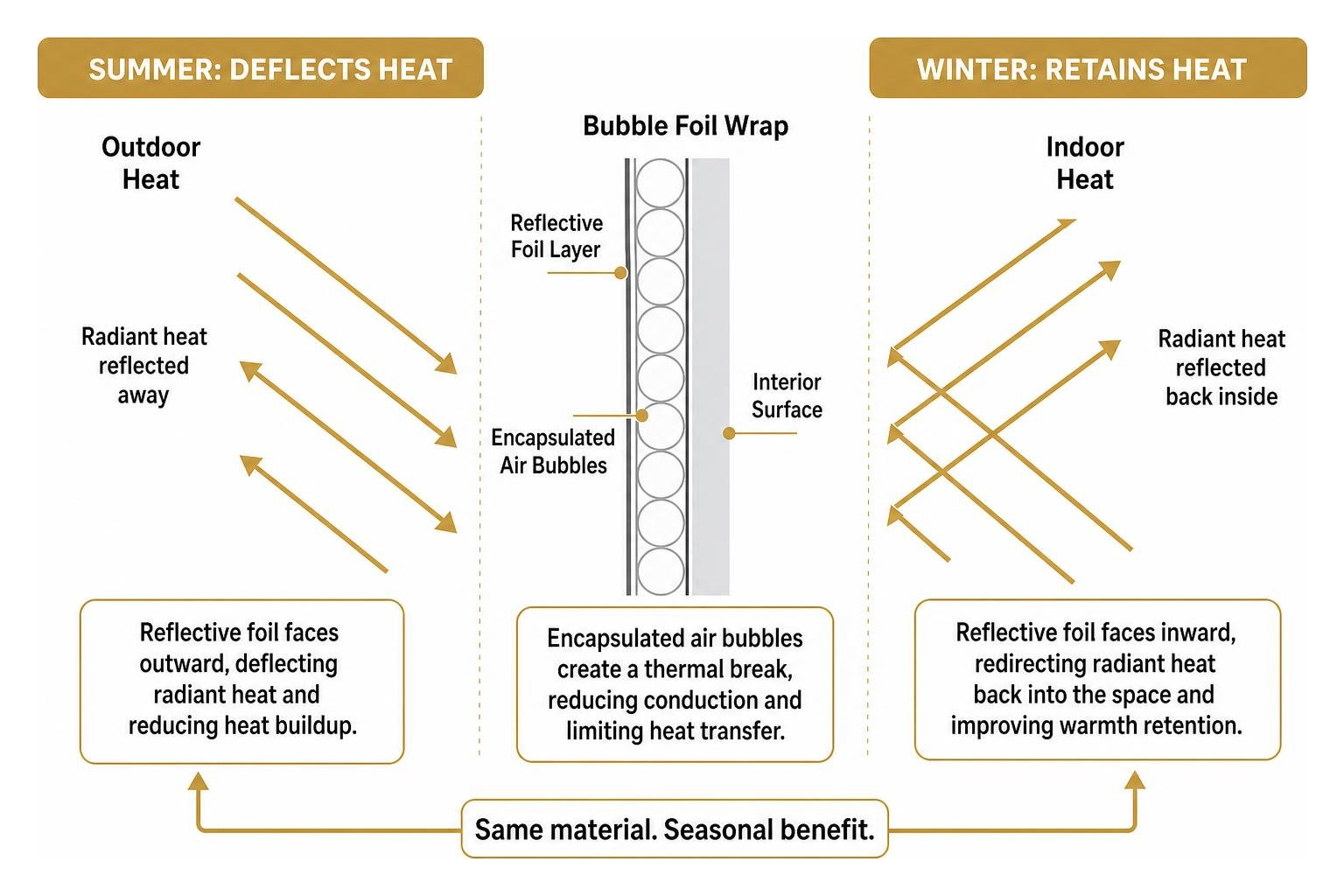
Thermal management relies on three fundamental mechanisms: radiation, conduction, and convection. Conventional insulation primarily resists conductive and convective heat flows, whereas reflective foil products target radiant energy transfer. High-grade double bubble foil insulation reflects up to 94% to 96% of radiant heat transfer away from structures during hot summer afternoons, significantly reducing heat buildup.
During cold months, the process reverses. Heat generated by heating systems radiates outward toward exterior walls and ceilings. An inward-facing reflective barrier redirects this radiant warmth back into the living or working space.
Meanwhile, the encapsulated air bubbles act as a physical thermal break, preventing warm indoor air from directly contacting cold exterior substrates. This stabilizes indoor temperatures and eases the load on climate control equipment year-round.
Radiant Heat Reflection vs. Conduction
To understand why this material performs so well, it helps to distinguish between heat conduction and thermal radiation.
- Conduction is heat moving directly through physical contact, such as warmth traveling through a solid metal beam or wooden stud. Traditional bulk insulation materials like fiberglass batts, mineral wool, and closed-cell spray foam are engineered to slow conduction by trapping air within dense fibers or cellular matrices.
- Radiation is electromagnetic energy traveling through space until it strikes an object and converts to heat. Sunlight warming a metal roof deck is a classic example. Bulk insulation absorbs this radiant energy and slowly transfers it downward into the building.
Reflective bubble products do not absorb this heat; they bounce it away. Foil surfaces feature an exceptionally low emissivity rating (typically between 0.04 and 0.05 per ASTM C1371), meaning they emit almost no radiant heat across adjacent air spaces.
Instead of allowing energy to saturate the structural envelope, the reflective surface turns away up to 96% of radiant energy. Pairing this with cellular air pockets slows convective airflow, providing dual-action protection against atmospheric temperature swings.
Single Bubble vs. Double Bubble Foil Insulation
Reflective bubble wrap is generally available in two primary configurations: single bubble and double bubble. Choosing the right option depends on your climate, moisture exposure, and thermal demands.
Single bubble insulation features one layer of polyethylene air bubbles bonded to one or two reflective foil skins, creating a slim profile around 1/8 inch thick. Double bubble insulation sandwiches two distinct layers of air pockets between heavy-duty reflective outer facings, bringing the total thickness to approximately 1/4 inch (about 6 mm to 8 mm).
| Feature / Metric | Single Bubble Foil Insulation | Double Bubble Foil Insulation |
|---|---|---|
| Total Thickness | Approx. 1/8 inch (3-4 mm) | Approx. 1/4 inch (6-8 mm) |
| Bubble Construction | Single polyethylene air cell layer | Dual independent air cell layers |
| Radiant Reflectivity | Up to 95%-96% | Up to 96% |
| Thermal Break Strength | Moderate | Superior (prevents thermal bridging) |
| Condensation Prevention | Effective in mild/moderate climates | Recommended for extreme temperature differentials |
| Standard Roll Dimensions | Typically 4 ft x 125 ft (500 sq ft) | Typically 4 ft x 75 ft (300 sq ft) to 4 ft x 125 ft |
| Recommended Applications | Mild attics, light packaging, duct wrapping | Pole barns, metal buildings, cold climates, crawl spaces |
The double layer of bubbles creates a more substantial internal air space. In regions with severe temperature differentials, this extra barrier prevents the outer foil skin's temperature from transferring directly to the inner surface, effectively preventing interior condensation and frost.
Thermal Performance, R-Values, and Condensation Control
Evaluating reflective materials requires understanding how their performance is measured in the building and packaging industries.
Understanding R-Value and Emissivity in Bubble Foil Wrap
A common point of confusion is the difference between a material's nominal R-value and its total assembly system R-value.
The standalone physical material of a 1/4-inch foil-faced bubble wrap provides a nominal conductive resistance of approximately R-1 to R-1.1. When manufacturers state system R-values ranging from R-4.2 up to R-14+, they are measuring the entire sealed installation assembly, which includes adjacent dead-air cavities.
Thermal resistance in radiant assemblies varies significantly based on installation orientation and heat flow direction:
- Heat Flow Downward (Summer Ceiling/Roof): Delivers the highest performance—often reaching R-14.1 or higher—because warm air naturally stays above the barrier while radiant energy is reflected upward.
- Horizontal Heat Flow (Walls): Delivers intermediate performance, typically rating around R-9.7 across a sealed assembly.
- Heat Flow Upward (Winter Ceiling/Roof): Delivers moderate performance (around R-8.6) because rising convective currents counteract radiant reflection.
Because of this, reflective barriers are evaluated based on surface reflectivity (95% to 97%) and thermal emissivity (0.04 to 0.05 per ASTM C1371) rather than bulk material thickness alone.
Preventing Moisture Buildup and Creating a Vapor Barrier
Beyond thermal reflection, bubble foil insulation serves as a continuous moisture and vapor barrier when properly sealed.
Condensation occurs when warm, moisture-laden air hits a cold surface (such as a sheet-metal wall or uninsulated floor joist), cooling the air past its dew point and forming liquid water. Over time, this leads to structural rot, rust, compromised insulation, and mold growth.
The impermeable polyethylene bubble core and solid aluminum or metalized layers prevent water vapor transmission (exhibiting perm ratings well under 0.05 perms). In unvented crawl spaces, basements, and commercial metal structures, installing double bubble insulation seals out ground moisture and stops condensation on overhead concrete or steel surfaces.
In sub-freezing climates, this barrier prevents interior humidity from condensing and forming frost on metal building framing.
Essential Installation Techniques and Seam Sealing
Correct installation is essential when working with reflective bubble products. The performance of a radiant barrier depends directly on how carefully it is installed.
The Critical Role of the Continuous Air Gap
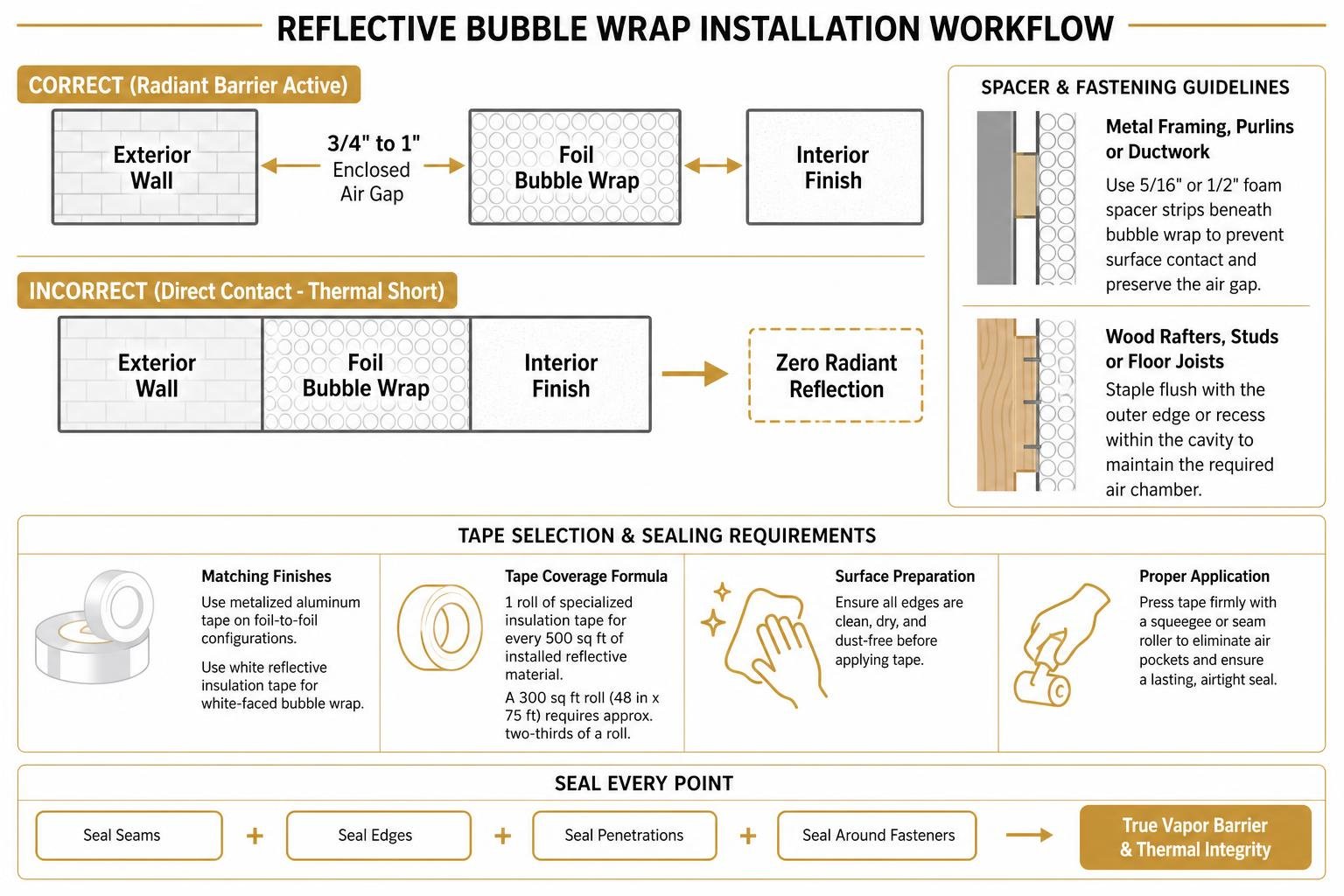
A reflective surface must face an enclosed air gap to function as a radiant barrier. If reflective foil is sandwiched directly between two solid building materials (such as OSB sheathing and drywall) without an air space, radiant physics cannot operate. Heat will simply conduct directly through the touching materials, reducing the assembly's effectiveness to roughly R-1.1.
To achieve optimal performance:
- Maintain an enclosed dead-air space of at least 3/4 inch to 1 inch adjacent to the reflective face.
- When wrapping metal framing, purlins, or ductwork, install thermal spacer strips (such as 5/16-inch or 1/2-inch foam spacers) beneath the bubble wrap to prevent surface-to-surface contact. This preserves the air pocket and increases the system's thermal performance.
- When fastening to wooden rafters, studs, or floor joists, staple the material flush with the outer edge or recess it within the cavity to maintain the required internal air chamber.
Tape Selection and Sealing Requirements
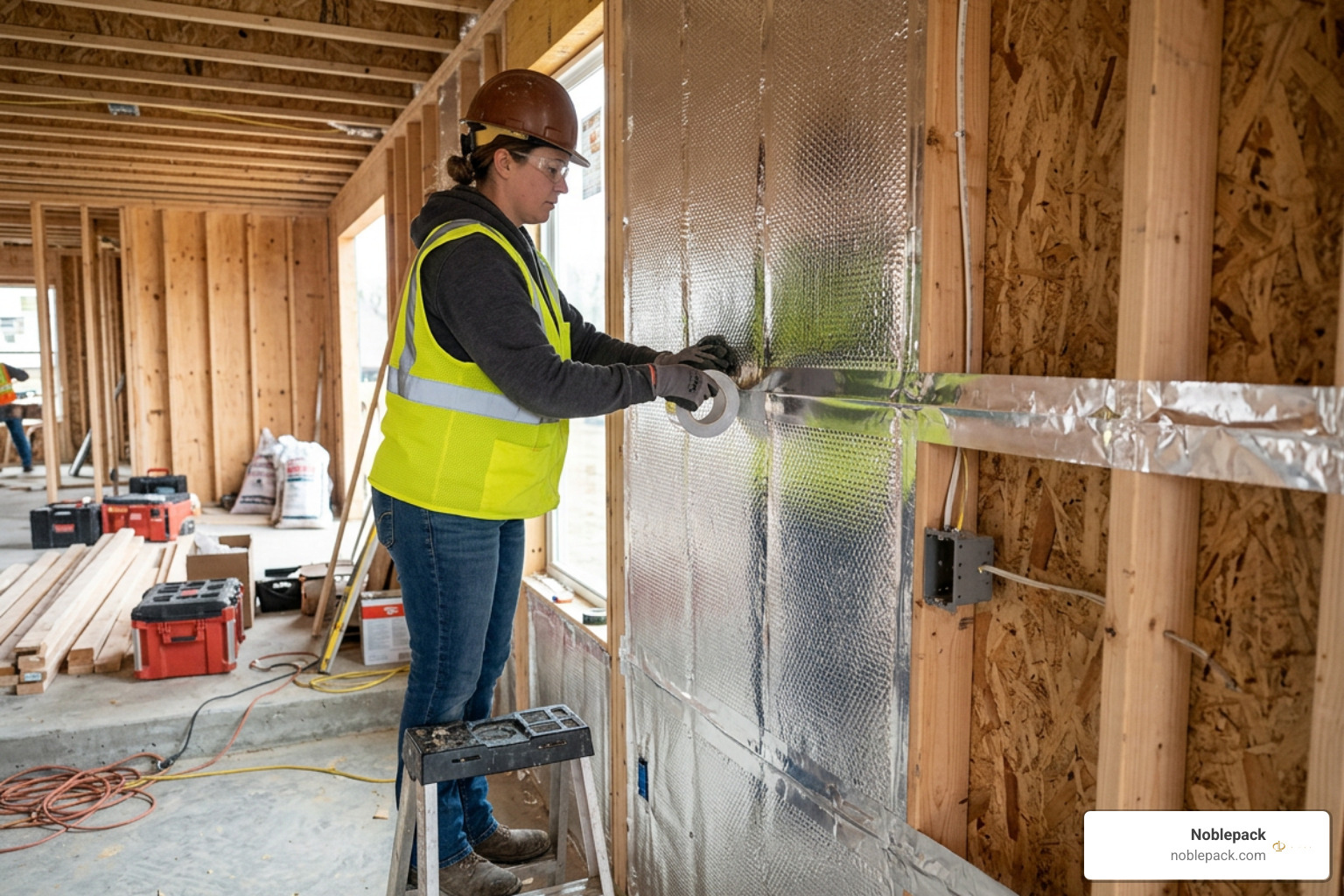
To establish a true vapor barrier and maintain thermal integrity, every seam, edge, and penetration must be sealed.
- Matching Finishes: Use heavy-duty metalized aluminum tape on foil-to-foil configurations. If you are using a white-faced bubble wrap for an exposed, clean interior look, use matching white reflective insulation tape along the joins.
- Tape Coverage Formula: As a standard rule of thumb, budget 1 roll of specialized insulation tape for every 500 square feet of installed reflective material. For example, a 300 sq ft roll (48 in x 75 ft) requires approximately two-thirds of a standard tape roll to secure its outer perimeter and overlap seams.
- Surface Preparation: Ensure all edges are clean, dry, and dust-free before applying tape. Press the tape firmly with a squeegee or seam roller to eliminate air pockets and guarantee a lasting, airtight seal.
To learn more about selecting the right adhesives for packaging and thermal products, review our dedicated guide on the best tape for bubble wrap.
Top Applications: From Building Structures to Protective Shipping
Because bubble foil wrap combines mechanical cushioning, thermal reflection, and moisture resistance, it is widely used across building construction, agricultural structures, and specialized shipping workflows.
Metal Buildings, Attics, and Crawl Spaces
Agricultural and commercial metal buildings are particularly prone to extreme seasonal temperature swings and condensation. During summer, uninsulated metal roofs absorb heat and radiate it downward, turning warehouses and pole barns into ovens.
Installing double bubble foil directly under roof purlins stops up to 96% of that radiant heat, lowering interior roofline temperatures by as much as 20°F.
In residential structures, staple bubble foil along attic rafters to bounce heat away before it reaches ceiling drywall and living spaces below. In crawl spaces and basements, fixing double bubble insulation across floor joists blocks rising ground moisture, prevents floorboards from buckling, and keeps living room floors warm in the winter.
Using Bubble Foil Wrap for Temperature-Sensitive Cargo
The same thermal principles that insulate homes make bubble foil wrap useful for protective packaging. When shipping temperature-sensitive, high-value merchandise—such as fine jewelry, luxury watches, electronics, and specialty goods—ambient freight conditions can pose a real risk.
Cargo bays in transit can easily reach 130°F on airport tarmacs or drop below freezing during winter line-hauls. Sudden temperature fluctuations can cause moisture to condense inside sealed containers, leading to tarnished metals, clouded gemstones, or corrupted electronics.
Using foil-laminated bubble wrap or insulated box liners creates a reflective microclimate that helps protect items against thermal shock and moisture for up to 24 hours in transit.
Pairing insulated bubble linings with durable jewelry mailer boxes gives delicate shipments both impact cushioning and temperature stability. For a step-by-step breakdown of shipping fine inventory safely, see our comprehensive jewelry shipping packaging guide 2026.
Frequently Asked Questions About Reflective Bubble Insulation
Is double bubble foil wrap effective in freezing winter climates?
Yes. Double bubble foil wrap is well suited for cold climates when installed with an enclosed air space.
Its dual-layer polyethylene air core creates a strong thermal break that stops interior heat from conducting toward cold exterior surfaces. Reflecting interior radiant warmth back into the building while preventing warm air from contacting cold framing reduces heating demands and helps eliminate winter condensation and frost buildup on metal surfaces.
What fire safety rating does reflective bubble foil carry?
High-quality reflective bubble insulation products carry a Class 1 / Class A fire rating tested under the ASTM E84 standard.
This test evaluates surface burning characteristics, confirming a low Flame Spread Index (typically under 20 to 25) and a low Smoke Development Index (typically under 30 to 50). This makes the material compliant with most standard residential and commercial building safety codes.
How much foil tape do I need per roll of insulation?
Plan for 1 roll of insulation tape per 500 square feet of bubble foil wrap.
If you are installing a standard 300-square-foot roll (48 inches wide by 75 feet long), a single roll of tape provides enough material to overlap all lengthwise seams, cap perimeter edges, and seal any mechanical staple penetrations to maintain a continuous vapor barrier.
Conclusion
Bubble foil wrap is a practical, high-performance solution for residential construction, commercial facilities, and temperature-sensitive packaging. Reflecting up to 96% of radiant heat in the summer and reducing heat loss and condensation throughout freezing winters, it offers dependable year-round thermal control.
To get the most out of your installation, remember the fundamentals: always provide a continuous 3/4-inch to 1-inch air gap next to the reflective foil face, maintain proper spacer clearance over metal substrates, and seal all seams with matching reflective tape.
For high-value retail shipments, pairing thermal foil protection with our premium protective bubble wrap guarantees your items arrive safe, dry, and secure. Connect with our team to discover how our protective packaging collections can streamline your shipping operations.